Dr. Grissea Fox (who also writes as Emma Barrett-Brown) is an author and historian from Plymouth, Devon. Here she presents bite-sized portions of local history, folklore, and so called "dark" history on her Official Blog.
Another nursery rhyme post to get me back into the swing of
posting! The other day my partner and I were discussing Jack and Jill and what
some of the elements of the rhyme might mean so I thought I would break it down
for you (and him!)
Firstly, let’s look at the lyrics:
Jack and Jill went up the hill to fetch a pail of water
Jack fell down and broke his crown
And jill came tumbling after.
Up Jack got and home did trot as fast as he could caper
And went to bed to mend his head
With vinegar and brown paper.
Now, anyone who has read my other nursery rhyme analysis
(which is available here!) will know that often rhymes like this are
metaphorical and tend to relate to real people or events.
I’ll start with a bit of language analysis. Let’s first look
at the word “Crown” – most people accept that Jack’s broken crown is in fact
the top of his head and that is perfectly plausible in the circumstances,
especially with the final lines to “mend his head”, so that is the most likely
usage here. There is a theory circulating online, however, that the word crown
might be more literal! This theory states that Jack and Jill were in fact the
poor deposed and executed monarchs Louis XViii and his infamous queen Marie
Antoinette! This seems to be a common theme from what I have seen online, and
certainly it seems to fit the bill – he fell and lost his crown and she came tumbling
after. It certainly could be describing those events. The extra evidence of
this given is that most people cite the first publication of the rhyme to be in
1795, two years after the pair fell to the guillotine… HOWEVER, this does not check
out and this rumour seems to have become an easily passed on myth! From my
research I have found a copy in 1777,[1]
and previous to that in 1765! So Jack and Jill is categorically NOT
about the French royalty of the revolution! Myth busted!
Printed in a 1777 songbook - see footnote 1
So, how old is Jack and Jill? That is the next question! The
first full publication of the rhyme I can find is currently 1765, however, I
have found references to Jack and Jill earlier! In 1744, an epic poem about the English Revolution
cites:
This rhyme was said to date from 1661. Now, to complicate
matters, it is true that the phrase “Jack and Jill” was often used to generally
describe and man and woman, often married (as early as Shakespeare), however it
is what it is accompanied by in this rhyme that caught my attention. Tom Thumb
for example being a creature of English Folklore. (Conversely, however, Wat
Tiller / Tyler was a real man who fought a rebellion against the crown in 1377,
however – like “Robin Hood” figures, his deeds are often remembered with folklore-like
twists of nostalgia and hero-worship). With the extra addition that this verse
speaks of music changing from merry to battle, and with reference to old
customs, could Jack and Jill actually be some lost element of English folklore?
This theory goes back further too! With a reference from the
1690s which refers to Jack and Jill as a children’s story! [3]
For my part, I would as soon commend the children's stories of Tom Thumb - and of Jack and Jill
- See footnote 3!
With this in mind, let’s have a look at any theories which
are said to originate prior to this!
“Jack and Jill Hill” in somerset is supposed to the actual
hill from the rhyme and gives a local folklore tale to explain it. This hill in
the 1805 original ordinance survey maps is actually entitled “Bram Hill”[4].
The tale told is a simple one, that a woman – Gill - was pregnant and that her
husband fell and died on Bram hill.[5]
The grief-stricken woman also died soon after and so her child was brought up
by the villagers, thus leading to the common usage of the surname Gilson in
that area. The evidence added is that in the 1765 Mother Goose version of the rhyme,
the spelling is “Gill” rather than Jill. This was supposed to have happened in 1697
however and so at once, this falls after the first mentions we have heard of
Jack and Jill as a “children’s story”. This
research also ties in with an earlier assumption made by Opie and Opie that the
form of the rhyme and the words used are from the seventeenth century (1600s) at
least.[6]
There is of course, the possibility that the rhyme
originated here using references to a previous children’s story which would
explain the links made here. However, I find this to be somewhat charming, but
unlikely.
One final set of theories is that the rhyme has Tudor or
Stuart Origin. Some say it was to do with
the execution of two noblemen, another that it was more to do with changes to
the size of measures for tax purposes (As in, a tax bill was blocked so instead
of raising taxes, the monarch – Charles I – reduced the size of the measure
instead) involving the archaic measurements of a Jack (Or Jigger) and a Gill.
To conclude. As ever with this type of thing, we never can know for sure the
origins of this rhyme, however, my money is on it being an old lost piece of
folklore – a “children’s” story which over the years was morphed into the rhyme
as we know it today. I can tell you for certain that it was not about Marie
Antoinette and her unlucky husband, and it seems unlikely that it was about
Gill of Somerset and her untimely demise.
[1] John
Arnold, The Essex Harmony ... Vol.ii. The Second Edition with large
Additions, 1777 (London: J Buckland Printers), p.130
[2] I
have modified the language used to make it accessible for the non-historians
out there! If you would like to see it in its original form, see Harleian
Miscellany, Or a Collection of Scarce, Curious, and rare pamphlets and tracts,
1744, Volume 2, Page 508, (available free to read on google books.)
[3] Vindiciæ
Anti-Baxterianæ: or, Some Animadversions on a book, intituled the life of Mr Rihard
Baxter, 1696, (London, Richard Standfast Dist), p.202.
[4] As
can be seen here: https://tinyurl.com/5n6s82nn
[5]
This theory is available to read in many blogs and websites, an example is: https://www.theimportanceofbeingtrivial.com/where-jack-and-jill-really-did-go-up-the-hill.html
[6]
Opie and Opie, The Oxford Dictionary of Nursery Rhymes (London: )p.
This rhyme is perhaps not so well known as others, but is often present in nursery rhyme books, especially older ones. I certainly remember it from my youth, and have during the research for this blog come upon it several times.
Firstly, it should be noted that there are several variants to the rhyme, the most notable of which is the change to a fine lady, from an old woman, during the 1700s. The rhyme, as printed in “Tom Tits Songbook”, (published in 1790 by C. D. Piguenit of Aldgate, London), actually goes thus:
Ride a cock horse to Banbury Cross
To see an old lady, upon a white horse
A ring on her finger,
A bonnet of straw,
The strangest old lady that you ever saw
As well as this, there are some variations which give Coventry Cross as the lady’s location, amongst other places. The question to be begged then, is can we deduce the identity of the “fine lady” or indeed, “Old lady” from the clues in the rhyme?
The first thing is to deduce the approx. age of the rhyme. So far, we know it is at least older than 1790, which disproves one theory found online, that the fine lady was in fact a Lady Katherine Banbury, from the late 1800s, despite how that lady bore the name Banbury and was well-known for riding a white horse with bells attached to her saddle. One place where it might be alluded to, is in a poem written in 1725 by Henry Carey which states “now on a cock horse he does ride”. This then, could potentially be the earliest mention of the rhyme. This could also, however, be alluding to one of several other rhymes which both start with the same line, “Ride a cock-horse” although of course it is more than possible that at one time these were all verses of the same rhyme or song. For example, in the 1744’s Tommy Thumb’s pretty songbook, the following lines were recorded:
Ride a cock-horse To Banbury Cross,
To see what Tommy can buy;
A penny white loaf,A penny white cake,
And a two-penny aple-pie.
Or, as seen in another pic here from Tommy Thumb's Book of Pretty songs, another very similar rhyme:
These verses, it could be argued seem to have the same rhythm and style of the fine lady variant and so add credulity to the idea that this rhyme was originally set into several different verses.
Whilst it might seem that the use of currency in the “Tommy” part of the rhyme is a good start to try to date it, it is most likely that the currency would change over the years, as the rhyme evolved, so this is in fact not an accurate measure at all. What might be more relevant, and has been cited by a number of other scholars, is the allusion to clothing in the “fine lady” verse. During the 25th century, it was, in England at least, fashionable to wear tapered shoes which often were decorated with tiny bells (the tradition of bells on shoes or around ankles or lower legs for Morris dancers also potentially comes from this era!) Couple this, then, with the history of Banbury Cross, which was destroyed in 1602 by puritans, and it would seem that there is strong evidence to show this fine, or old, lady was likely of the 15th century. What must be noted however, is that there were other crosses in Banbury at the time, so although unlikely, it is possible that the rhyme refers to another cross.
So, the next step in this mystery is to look into what notable and fine ladies might have been likely candidates for such a rhyme. Firstly to note is that although in general a cock-horse might have been a spirited horse, or a horse which was brought in to assist in pulling carts where the terrain was difficult, during the 16th century at least a cock-horse could also allude to a child’s toy horse, something like a hobby horse. This then, especially if the rhyme is actually a children’s rhyme, brings the imagery of the children lining up to look out at the lady, a procession perhaps for royalty, or personages of note. In his 1962 book, the “Annotated mother goose” history scholar, William Baring-Gould comments that there are three distinct possibilities as to the identity of this mystery woman. That it was Elizabeth I, that it was a medieval noblewoman named Lady Godiva, or that it was a different noblewoman named Celia Fiennes. Let us examine each of these ladies individually! Elizabeth I is certainly a good contender for the part. Certainly, Banbury cross was present during her reign, which is eveidenced both by knowledge of when the stone fell, and also by the comments of a Mathew Knight in 1604 who stated:“remembraunce all the publique proclamacions of our late soueraigne Ladie Quene Elizabeth and of her (most) noble progenitors that were directed thither to be proclaymed were alwaies made and proclaymed vpon the step~ or grises of the same heigh Crosse” (That is, that all royal proclamations given by the then Late Elizabeth, were read out by the Babury representative at Banbury Cross.)
The white horse, in this case, could symbolise not just royalty, but also the white for the “virgin queen”. However, it can also be seen that despite there being many uncited references to Elizabeth I visiting Banbury for the erection of the Banbury cross, thus far I have found no sources to cite this, in fact in his 1841 book on the history of Banbury, A Beesley made no mention of Elizabeth ever having visited. Another fact to consider is that Elizabeth might have been a little late (about 100 years) to be wearing the shoes with bells on, although as an extravagant dresser, it’s still possible she wore such accessories.
The second lady who this rhyme is cited to be about is Lady Godiva, a noblewoman from 1067 who is said to have ridden naked through the streets as a protest against high taxes. Whilst Lady Godiva was a real historical figure, her deeds are the stuff of legends, namely legends created in the 13th century! Other than the obvious connection of a “fine lady on a white horse” there is little but speculation to link this rhyme to Lady Godiva. The third and final lady to consider is that of Celia Fiennes. All that is really known of Celia is that she was a noblewoman who was well-known for being a keen rider. The story here, is that the original verse was “A Fiennes Lady” rather than a "Fine" Lady. Celia was also sister to the viscount of Banbury castle, so there is a connection there. She was, however about 100 years late to be visiting Banbury cross, having been born in the late 1600, so 100 years after the cross was destroyed! An anecdote mentioned in the Oxford dictionary of nursery rhymes states that this version of events was actually made up by the antiquarian who claimed to discover it! Overall then, it would seem that the fine lady on the white horse was most likely to be Queen Elizabeth I. Despite some discrepancies, she seems to fit the most comfortably into the clues given by the rhyme!
Sources used:
Baring-Gould, William Stuart, and Ceil Baring-Gould, The Annotated Mother Goose, Nursery Rhymes Old And New, Arr. And Explained By William S. Baring-Gould & Ceil Baring-Gould, 1st edn (New York: C.N. Potter, 1962)Beesley, Alfred, The History Of Banbury, 1st edn (London: Nichols and Son, 1841)
Candicott, Randolf, "Ride A Cock-Horse To Banbury Cross & A Farmer Went Trotting Upon His Grey Mare : R. Caldecott's Picture Books", Project Gutenberg, 2017 <http://www.gutenberg.org/files/18596/18596-h/18596-h.htm> [accessed 4 April 2017]
Gurton, Gammer, "Gammer Gurton's Garland, Or, The Nursery Parnassus : A Choice Collection Of Pretty Songs And Verses For The Amusement Of All Little Good Children Who Can Neither Read Nor Run : Ritson, Joseph, 1752", Internet Archive, 2017 <https://archive.org/details/gammergurtonsgar00ritsiala> [accessed 4 April 2017]
Harvey, P, "Where Was the Banbury Cross", Oxoneinsia, 1966, 83 - 106Heaney, Michael, "Kingston To Kenilworth: Early Plebeian Morris", Folklore, 100 (1989), 88-104
Opie, Iona Archibald, and Peter Opie, The Oxford Dictionary Of Nursery Rhymes, 1st edn (Oxford: Oxford University Press, 1997)
Opie, Iona, Joan Hassall, and Peter Opie, The Oxford Nursey Rhyme Book, 1st edn (Oxford: Clarendon Pr., 1977)
Baring-Gould's 1962 "Annotated mother goose", about halfway through, gives a very stark little rhyme, which reads:
Ladybird, ladybird
Fly away home
Your house is on fire And your children will burn[1]
Now, I remember this from my own childhood with a still horrific but slightly more gentle
Ladybird, ladybird Fly away home
Your house is on fire
And your children are alone
Occasionally adding a final line: All except Little Anne, Who’s hiding under the frying pan![2]
Of course, as a child, there seemed nothing at all amiss about ladybird’s houses being aflame, but as an adult this is another rhyme which feels like it must have some other hidden meaning within!
Ok, so as always, I first like to turn to trying to find origins and early publishing dates. the earliest I could find for this particular one is actually right back in the 1700s to the original Tommy Thumb booklet! It does also appear to be in the form of the less optimistic original telling there.[3] Tommy
Thumb’s little song book is actually considered to be the oldest surviving book of nursery rhymes, and so most of the content are likely older, but no other examples survive in collections like this. As yet, this is the earliest version of Ladybird, Ladybird I have found. Other places it might exist, especially if it does turn out to be topical, are on old broadsheets or pamphlets However, thus far none of these seem to survive. Tommy Thumb’s song book, incidentally, might actually be one of the earliest books designed for children ever put to the printers![4]
Our friend James Orchard Halliwell seems to have been one of the first to add the final line with his 1842 rendition:
Lady bird, lady bird, fly away home, Thy house is on fire, thy children all gone, All but one, and her name is Ann, And she crept under the pudding-pan[5].
So, what’s it about? Who is the ladybird and why was her house on fire?
One of the main theories I have come across in texts old and new, is that this rhyme about religious persecution. People don’t seem to agree, however, on who it was being aimed at!
Theories range from it being a repression of the ancient gods in favour of the masculine sky gods of ancient Greece, to the repression of British and Celtic paganism, with the first line being a taunt of “you are defeated” to the latter, newer lines being a nod to the fact that paganism survived.[6] Despite being a pagan myself, and delighting in this idea, it is actually highly unlikely that this rhyme is this old despite that throughout many cultures Ladybirds have been considered sacred for eons and are thought to bring luck to those who they land on.
Another theory, especially since this rhyme was very likely known during the 1500 and 1600s, is that it was actually being aimed at Catholics, with the actual word “ladybird” deriving from “our lady” originally.[7] With this in mind, this actually begins to pull together. The form of this rhyme is very similar in form to other rhymes written in the 16th century, (little Bo Peep, for example) and possibly carries a subtle nod to the virgin Mary, so I would surmise it likely to be a nod to the persecution of Catholics during the reign of Elizabeth 1st. Fly away home because your homes are burning and your families at risk. As for Ann – well, to go there, I’d just be guessing with no evidence so I won’t fall into that trap! 😊
Final words on this one are that it does seem that nobody really knows and so this one falls a little more into obcurity.
[1] William Barring-Gould, Annotated mother goose, (New York: Bramhall House Publishing) 1962, p.209 [2] Or, as cited in Chris Roberts, Heavy Words Lightly thrown (London: Granta) 2004, p.53 “Under the warming pan” [3] Mary Cooper, Tommy Thumb's Pretty Song Book, (London) 1744, p.5. Copy held by the British library - The British Library, 2017 <https://www.bl.uk/collection-items/tommy-thumbs-pretty-song-book> [accessed 11 April 2017] [4] British Library, Tommy Thumb’s Pretty Songbook, https://www.bl.uk/collection-items/tommy-thumbs-pretty-song-book [5] James Orchard Halliwell, The Nursery Rhymes of England: Collected Principally from Oral Tradition, (London: The Percy Society) 1842 p158 [6] Opie and Opie p.309 [7] Michael Majerus, A natural History of Ladybirds, (Cambridge, Cambridge University Press) 2016, p.2
This little rhyme is one of the most well-known nursery rhymes and is still recited by children from all over. There are two popular theories that I can find from a brief search on google, as to its origin and meaning, with one camp attributing it to a Dr Thomas Muffet (who died in 1604), as an ode to his stepdaughter, and others claiming it is a metaphorical reference to Mary, Queen of scots. I thought I would investigate these two theories for you today :) First and foremost, an examination of the rhyme in printed literature:
The earliest recorded version of this rhyme would appear to be an 1805 book entitled “Songs for the nursery”. An 1808 reprint of this is available online at archive.org (see references below). An early tome which is considered the original book of nursery rhymes, “Tommy Thumb’s pretty song book”, printed in 1744, does not hold any reference to this rhyme. The verse seems to have come to popularity in the mid-nineteenth century amongst those recording nursery rhymes, and especially after 1878 it was reprinted multitudes of times. Despite that the rhyme was often printed with slight variances (a “black spider” etc) it was pretty much the same verse. In his 1849 tome on nursery rhymes, James Halliwell Phillips neglected to add Miss Muffet, but included it as “Little Mary Ester, Sat upon a tester, Eating of curds and whey.” This is interesting in the fact that Halliwell-Phillips was an avid collector of nursery rhymes and therefore could tell us that before 1850, the “Miss Muffet” version was perhaps a lesser known variant. The Mary Ester version is claimed (by Opie and Opie, who were experts on the subject of nursery rhymes) to originate in 1812 in printed material, however I have been unable to locate a copy to confirm this.
In 1878, William Adolphus Wheeler reprinted the rhyme with the Miss Muffet opening line, alongside two very closely similar verses, the most notably similar being:
Miss Poll Parrot,
Sat in her garrett
Eating some toast and tea
A little brown mouse
Came into her house
And stole it all clean away.
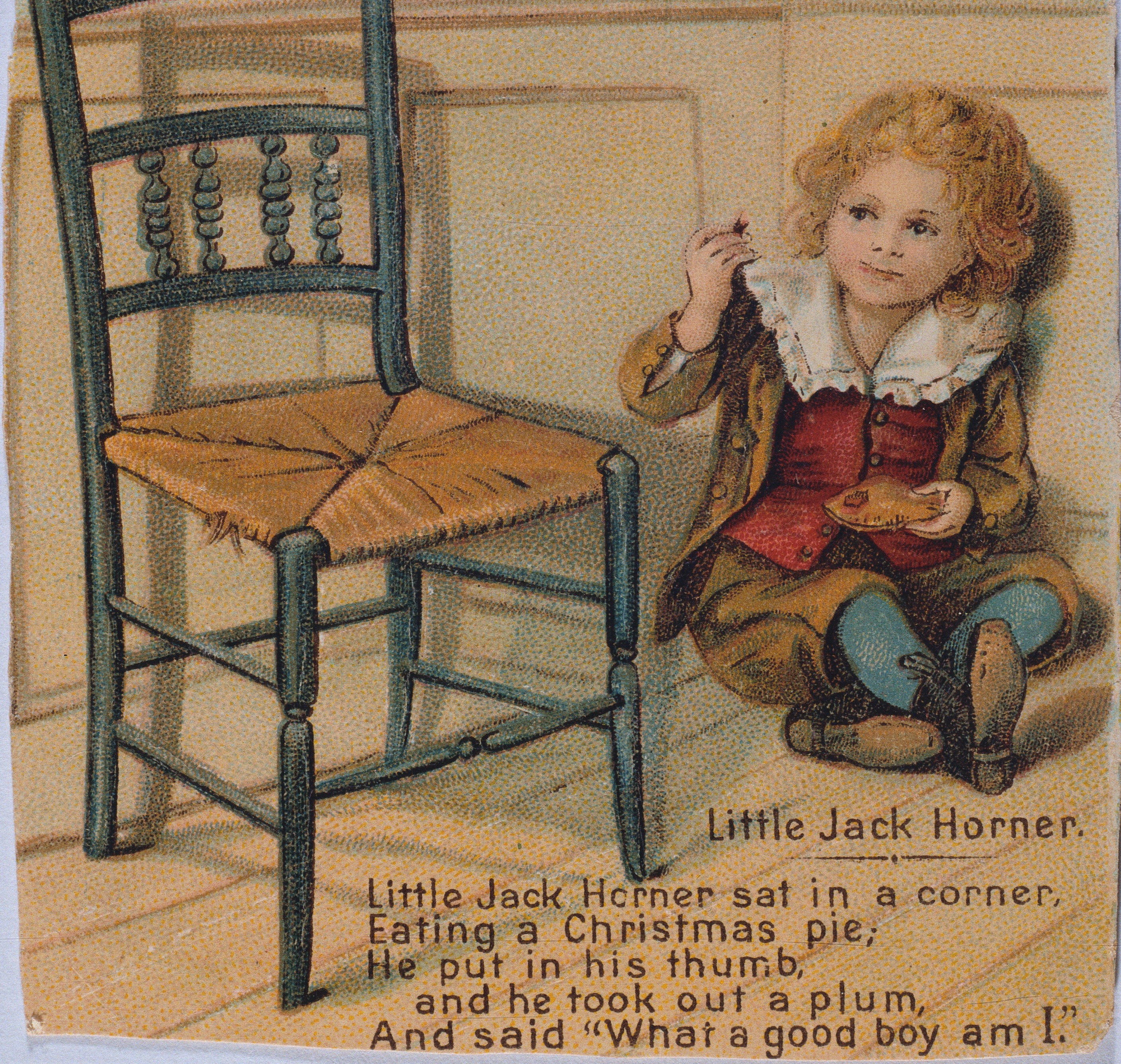
Opie and Opie discuss in their 1955 dictionary of nursery rhymes, how similar some of the form of the rhyme is to “Little Jack Horner” which was a popular rhyme first found in chapbooks in the early eighteenth century (1720).
Opie and Opie also list a multitude of other potential originals, discussing the idea of somebody sitting and pursuing an action (mainly eating something) which is then interrupted by somebody or something arriving or another important action.
So, firstly, let us examine the wording used in the rhyme. Nowadays, the word Tuffet is used to describe a footstool fairly commonly, however this has not always been the case. In fact, it might even be that the use of the word tuffet has come from people’s interpretations of this rhyme, and especially the illustrations of it which show the lady on a foot-stool. Prior to the nineteenth century, a tuffet was more likely describing a grassy knoll, therefore indicating that Miss Muffet had taken her food outside.
And what of that food? Curds and Whey, pretty much, are like a sweet cottage cheese. They are a by-product of cheese-making and have been around for centuries (as long as cheese-making), and so this gives no clue as to the date of the rhyme.The name little Miss Muffet might give a clue though. One of the most popular theories about the origins of this rhyme allude to a Dr Thomas Muffet who was an expert on insects in the 1500s. in 1885, he was listed in the dictionary of national biography to have been especially interested in spiders. Whilst this this rather a coincidence, and fun to imagine how perhaps he wrote the rhyme to tease one of his step-daughters, there is literally no evidence whatsoever to link the rhyme to this man, other than the coincidence of his name and profession. He is not known for writing poetry or rhyme, and there is no evidence that he wrote this one especially considering that the rhyme only appears in 1805.
Another version of this theory, (as quoted by the North Mymms History Project Website) pertains to the poem being written about Dr Muffet, rather than by him, and discusses the use of spiders in 16th century medicine and how he frightened his daughters by keeping spiders in the house or even dumping spiders on them.Now, I have not researched extensively into the use of spiders in medicine, but aside from the use of spider’s webs in bandage making, I can find no evidence to support spiders being used medicinally by Dr Muffet, however, I suppose it is plausable. In fact, and I did not spend a great deal of time on this, I struggled to find any academic references at all to sixteenth century doctors using spiders as medicine. (If you know of any do feel free to educate me by posting in the comments!) What I did find, however, was nineteenth century writing on medicine which alluded to swallowing and touching spiders in order to cure, amongst other things, spider phobia! (Frank Cowan’s 1865 book, curious facts in the history of insects for example). During the nineteenth century, especially later in the nineteenth century, there was a surge in the emergence of interest in science, including natural sciences, and so it is highly possible that doctors such as Dr Muffet were once again taking the attention of science scholars. An example of this is in a journal (a monthly or sometimes quarterly academic magazine-like book) from 1886, where Dr Muffet was the subject of a whole article. So perhaps if there is a link here at all, it is perhaps feasible that this well-known spider enthusiast loaned his name to the late eighteenth/early nineteenth person who penned the rhyme – but this is pure speculation at this point.
Another popular theory, many, many websites and blogs tell me, is that the rhyme is a metaphor for Mary, Queen of Scots. However, I have actually struggled to find anything of note about this theory other than that Miss Muffet was Mary, Queen of Scots, and that the “spider” was John Knox who was a religious reformer. Therefore, this seems almost to be an internet myth in itself, with very little to no actual evidence to it. Nowhere in literature have I found John knox referred to or even characaturised as a spider, and there is no link with the muffet name to Mary.
Conclusion.I’m afraid the answer to this one, like with so many nursery rhymes, is that we just don’t know. The facts of the matter are that the rhyme in it’s popular format was first published in 1805, but was based on an older style rhyme, and that in the 1500s there was a doctor who was obsessed with spiders by the name of Muffett. My personal feeling on this one, is that the rhyme itself, in structure and style, is just another version of a much-used formula which originated many years prior to 1805, albeit with different words, and that the Miss Muffett reference was an 18th century memory of a doctor who was obsessed with spiders, but in the end, that’s majoratively speculation.
References
Cahan, David, From Natural Philosophy To The Sciences (Chicago: The University of Chicago Press, 2003)
Collingbourne, Huw, "Tuffets And How To Sit On Them", Sircourtlynice.Blogspot.Com, 2010 <http://sircourtlynice.blogspot.com/2010/09/tuffets-and-how-to-sit-on-them.html?m=1> [Accessed 4 July 2019]
Cowan, Frank, Curious Facts In The History Of Insects; Including Spiders And Scorpions. A Complete Collection Of The Legends, Superstitions, Beliefs, And Ominous Signs Connected With Insects; Together With Their Uses In Medicine, Art, And As Food; And A S By Frank Cowa (Philadelphia: Lippincott, 1865), p. 395
Opie, Iona, and Peter Opie, A Nursery Companion, 2nd edn (Oxford: Oxford University Press, 1997, originally printed 1951), p. 382
Tabart and Co, Songs For The Nursery, 2nd edn (London: Bond Street, 1808), p. 23
"Tommy Thumb's Pretty Song Book", The British Library Collection Items, 2019 <https://www.bl.uk/collection-items/tommy-thumbs-pretty-song-book> [Accessed 4 July 2019]
Wheeler, William Adolphus, Mother Goose's Melodies (Cambridge: Hurd and Houghton, 1878), p. 72
So, I'd imagine many of us have sung this as a child, perhaps making the actions of marching up and down hills along with it as is dictated in many a playground... but who was the Grand Old Duke of York, and why did he do all this marching?
Firstly, in case you don't know it, here's the rhyme.
Oh, The grand old Duke of York,
He had ten thousand men;
He marched them up to the top of the hill,
And he marched them down again.
And when they were up, they were up,
And when they were down, they were down,
And when they were only half-way up,
They were neither up nor down.
In looking into the origins of this rhyme, I was expecting to stumble over a theory or two about who this Duke of York might be, and in truth that much is true - there are quite a few! However, what I also found was a list of variations which seem to be older than the Duke of York version, the oldest of which (according once again to our friend James Halliwell-Phillips) actually spoke of "The King of France with forty thousand men," who "came upon a hill and so came downe againe"This is quoted in the satire "Pigges Coranto, or Newes from the north" which was written in 1640. The song which includes it is labelled "Old Tarlton's Song.Tarlton, from what I can discover, was a "Clown" or comedic writer from the mid-fifteen hundreds although Halliwell-Phillips claims that he didn't actually write some of the tracts he is known for. He was, however, very well esteemed and considered a great wit!
Another version of this rhyme is that which includes the Dutch commander Maurice of Orange. It loosely translates to :
The hero prince Maurice
came with a hundred thousand men
with them he went up the hill and also down again
This version, however, is most likely to be a direct copy of the English version, and likely originated in it's English form. So, bearing in mind that originally this rhyme was not about a "Grand old Duke", let's ponder who might be being referred to in the modern version of the rhyme. Firstly, we have no clues about the date it was recorded, with the first complete version being found in 1913's Mother Goose (by Arthur Racken). Opie and Opie, however state that there is a version which references a Duke of York recorded in 1890 but is not the complete version we know now.
From here on in, the answer seems to come down to speculation. Could it be an early reference to Richard, Duke of York (1411–1460) who died during the war of the roses atop the Bailey of a Motte and Bailey castle with 8000 men? This theory seems unlikely due to the fact that this song was likely not written for another hundred or so years, and the details of the early versions don't match up.
More likely, this rhyme speaks of a battle during the French revolutionary wars. After the French Revolution, war broke out all over Europe with France, under it's revolutionary government. This conflict is perhaps too much to go into here, but suffice to say that during this skirmish, England launched what was to be known as the Flanders campaign. Flanders, in northern France, is well-known for being a very flat country, but with the exception of Cassel, a small town built up on a Hill. The leader of this campaign was Prince Frederick (d. 1827) who was Duke of York at the time, and whose campaign ended in defeat and the humiliation of being recalled to England. In this case then, the term "grand old Duke" could have been satirical or sarcastically spoken, rather than respectfully and with reverence. As stated above, however, this is mere speculation, and this modern version of the rhyme could in fact be one of many Dukes of York.
Sources:
Opie, Iona Archibald, and Peter Opie, The Oxford Dictionary Of Nursery Rhymes, 1st edn (Oxford: Oxford University Press, 1997) PIGGE, Pigges Corantoe, Or Newes From The North. [A Political Satire.], 1st edn (London, 1642) "Pigges Corantoe, Or, Nevves From The North. - LUNA: Folger Digital Image Collection", Luna.Folger.Edu, 2017 <http://luna.folger.edu/luna/servlet/detail/FOLGERCM1~6~6~163446~109948:Pigges-corantoe,-or,-Nevves-from-th> [accessed 27 April 2017] "Tarlton's Jests, And News Out Of Purgatory: : Halliwell-Phillipps, J. O. (James Orchard), 1820-1889, Ed : Free Download & Streaming : Internet Archive", Internet Archive, 2017
First found in a rhyme collection in 1815, this rhyme is not apparently as ancient as some nursery rhymes, especially since it would appear that it doesn’t pre-date this time.This rhyme, it would seem, is much more literal than some of the others we’ve looked at so far as it alludes, quite simply, to the tradition of candle leaping. Most notably, in England there is a feast to Saint Catherine (25th November) which is sometimes known as Catterns day. St Catherine is the patron saint of spinsters, and was celebrated by lace-makers, spinners and rope-makers throughout the 1800s. At the culmination of these celebrations, a lighted candle would be jumped for luck. If it remained alight, then St Catherine was said to have granted such luck, and the following year would be prosperous. Sadly, despite the great value of lace, the lace-makers did not often have a great deal of money and since candles were expensive, often they would work with just one candle burning. Perhaps this is how Candle jumping became a part of the Catherine’s day celebrations.
Another reference to this custom is in social/local historian Ginette Dunne’s “fellowship of song”. This book is a study of singing traditions which was published in 1980 and contained what is now known as “Oral History”, that is an examination of stories told first hand to the researcher (Or in some cases recorded for later use by various researchers). In this study, Ginette records the experience of a man named Ben Lings who recalled seeing the ladies of the village, at Christmas, hitching up their skirts to leap the candle whilst singing this rhyme.
References Dunn, Ginette, The Fellowship Of Song, 2nd edn (Routledge, 1980), p. 118
Opie, Iona Archibald, and Peter Opie, The Oxford Dictionary Of Nursery Rhymes, 1st edn (Oxford: Oxford University Press, 1997), p. 268
This rhyme I felt I already knew for sure the origin behind. Indeed, even when discussing this project with a friend, they remarked “Oh, like how Ring a Ring o' Roses was sung about the black plague in London?” to which I nodded without hesitation. However, it would seem that this is a contested “fact” and does indeed seem to fall into the “urban legend” category. In fact, as stated by Simpson and Roud in the Oxford dictionary of English Folklore, this belief (of the rhyme’s origins) has no evidence to back it up and is “almost certainly nonsense.”. They give several points of evidence. Firstly, that the rhyme does not seem to appear in print before 1881, therefore quite late for nursery rhymes which have a tendency to pop up in the earlier eighteenth century tomes such as Tommy Thumb's song book if they are older, these being the first collections of early rhymes. Therefore it is unusual for a nursery rhyme NOT to appear during the late 1700s if it was an old one and 1881 is very late. Secondly, and agreed by Opie and Opie, the well-known "folkloreists" who wrote the Oxford dictionary of nursery rhymes, amongst other titles, that the theory of it being attributable to the black plague is only traceable to 1951, and that before then, it was not considered such.
Firstly, a quick overview of the Bubonic Plague is in order. Many people might believe that the black
death first appeared in 1665 in London, but this is not the case. In fact, it was already rife in Europe in the 1300s. Its main symptoms were blackening of the skin in patches (ring of roses?), inflamed glands, vomiting, headaches and then death. In London, 1665, it not so much as broke out again, but increased in deadliness. London was a crowded and dirty place to be and so gave the perfect environment for the plague to gain a stronghold, such as it did. Germs travelled quickly and so this, the main and last London outbreak spread quickly not just throughout London, but throughout England entirely, killing thousands of people in its wake. It should be noted here, in discussion of this rhyme, that sneezing was not one of the main symptoms of the plague, although some experts believe that its final stage might have included coughing up blood. The pocket full of posies could also be attributed to plague symptoms, where frightened citizens took to carrying “nosegays” (little bunches of flowers) to both ward off the disease and to cover the stench which would have been horrendous. Here it can be argued then, that the words of the rhyme do seem to fit rather nicely with the symptoms of the plague, so what could be the reason for the nay-sayers?
Firstly, the fact that the rhyme was not known before 1881 is an important point. Whilst it is true that many children’s rhymes were being repeated from person to person for sometimes hundreds of years before they were recorded, it is also true that the tradition of recording them to paper began perhaps a hundred years before this in the late eighteenth century (1700s). It seems very strange that when publications such as Tommy Thumb’s Songbook, Tom Tit, and Mother Goose Melody were already old news, this particular ditty was simply “missed”. This is especially true if it did indeed date back to the plague years, as to have survived such a length of time, it would have to have been at least fairly well-known. Another argument against this theory is the vast amount of variation in the wording of this rhyme. In 1898, for example, twelve different versions were recorded by Lady Gomme. Other versions include:Ring a ring a roses, a pocket full of posies, one for me, one for you and one for little Moses.Ring a ring a roses, a pocket full of posies, ash-a, ash-a, all stand downRing a ring a roses, a pocket full of posies, The king comes, the king comes, all bow down!And so on…As is stated by Opie and Opie, despite how the 1881 version is the most well-known, there is no evidence to prove definitively that this was the original version. Finally, it is worth noting that, especially during the 1900s, “ring games” were on the rise. These games were played by children, and often involved holding hands and dancing in a ring, whilst
singing or chanting a song. Examples of this are “In and out the dusty bluebells”: an English song-game said to be influenced by the hiring of young people by farmers for the summer months at the May fair. “The Farmer’s in his den” (or dell, or field) is a German rhyme originally from the 1820s, and “A tisket, a tasket” is an American variant of this type of game about a lost letter. All of the games had in common that they also contained a task, or action to perform. Opie and Opie, in their 1985 book “The singing game”, discuss how Ring a Ring o' Roses can be much likened to these other games, and that the “fall down” or “bow down” at the final line might in fact simply be the action.
To conclude this entry then, whilst the subject matter of Ring a Ring o' roses might allude to the black plague, it is unlikely that it dates from it. Most likely, it is a Victorian children’s rhyme from a singing, or ring, game.
Sources: Baring-Gould, William Stuart, and Ceil Baring-Gould, The Annotated Mother Goose, Nursery Rhymes Old And New, Arr. And Explained By William S. Baring-Gould & Ceil Baring-Gould, 1st edn (New York: C.N. Potter, 1962) Gomme, Alice Bertha Merck, The Traditional Games Of England, Scotland, And Ireland, 2nd edn ( Dover, 1894) (Ebook available: https://archive.org/details/traditionalgames02gommuoft )Gurton, Gammer, "Gammer Gurton's Garland, Or, The Nursery Parnassus : A Choice Collection Of Pretty Songs And Verses For The Amusement Of All Little Good Children Who Can Neither Read Nor Run : Ritson, Joseph, 1752-1803 : Free Download & Streaming : Internet Archive", Internet Archive, 2017 <https://archive.org/details/gammergurtonsgar00ritsiala> [accessed 4 April 2017]Opie, Iona Archibald, and Peter Opie, The Oxford Dictionary Of Nursery Rhymes, 1st edn (Oxford: Oxford University Press, 1997Opie, Iona, Joan Hassall, and Peter Opie, The Oxford Nursey Rhyme Book, 1st edn (Oxford: Clarendon Pr., 1977)Shrewsbury, John Findlay Drew, A History Of Bubonic Plague In The British Isles, 1st edn, 1970"Tommy Thumb's Pretty Song Book", The British Library, 2017 <https://www.bl.uk/collection-items/tommy-thumbs-pretty-song-book> [accessed 11 April 2017]
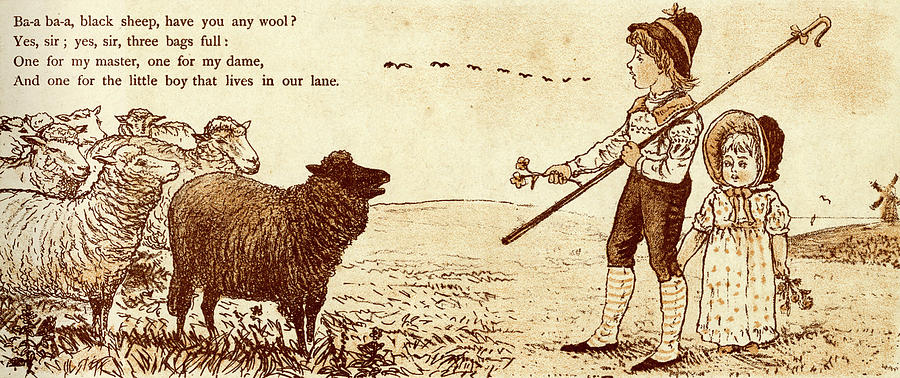
In 1774, a chapbook entitled “Tommy Thumb’s Pretty Song Book” was first published in London, England. This book is now ultra rare, with only two copies remaining intact, one of which is is held by the British library. This book was the second part of a set which is described by the British Library catalogue as being the first ever compilation book of nursery rhymes in print. It was in this book, that the rhyme “Bah Bah Black Sheep” was first recorded in its original form:
Bah, Bah, a black sheep,
Have you any Wool?
Yes merry, I Have,
Three Bags full,
One is for my Master,
One is for my Dame,
One is for the Little Boy
That lives down the lane
The final line, however, was changed by 1765 to "the little boy who cried in the lane" and has since then been changed back to the original. As you can see, there’s not a great difference between the original lyrics and today’s lyrics, but the question is begged, what is it about? Is there any significance to the black sheep, or the three bags for the specific people? Firstly, it should be noted that this rhyme is probably one of the most contentious of the nursery rhymes, with several schools in America and Australia banning it or even changing the lyrics to “rainbow sheep”, or adding an extra verse “baa baa white sheep” The most likely reason for this controversy is that in the 1980s, several experts suggested that it might be linked to the slave trade. This theory however, has no evidence to back it up, and so cannot be confirmed. New Scientist Magazine even ran a small article in 1986 which attempted to squash this rumour, reminding readers that the plantation slaves to whom the rhyme was being attributed tended to farm cotton, not wool, and also that the rhyme was likely a lot older than its 1744 publication, due to how rhymes were often passed mouth to mouth for many many years before being committed to publication.
Another often given explanation for this rhyme is that of wool tax. In 1275, Edward I put a tax on wool, which raised its price by up to a third of its value. This then, led to grievances amongst the shepherds and the “black sheep” could be explained as an expensive deviation, since it’s wool could not be dyed, limiting it to black cloth only and thus decreasing its value. In 1930, Katherine Thomas, a scholar, published a book named “The real personages of mother goose”. Here, she considered how, centuries later than the wool tax, the already present discontent amongst the poor was in fact exacerbated by the low wages paid to farmers and shepherds in the time of Henry VIII, and that in Exeter there was a rising of several thousand people. She concluded that the Master and the Dame could refer to the king and queen, or simply nobility of the time, and refers to “the little boy who cried in the lane” being unable to afford his own wool. Sadly, the lyric she quotes, of the little boy crying in the lane, is not the original, as seen above, and likely was found in the 1765, “Mother Goose Melody” version of the rhyme. Therefore, it is likely that she was unaware of this earlier version.
Further investigation into the wool trade in the 1700s, closer to the time of publication of this rhyme, shows that there was another event which would have directly affected it during the reign of William and Mary in the late 1600s, that is, the restriction of the exportation of wool from England and Ireland. This led to conflict amongst clothiers and wool merchants within England and Ireland, due to the fact that the Irish merchants took little notice of legislation, and continued to trade, angering the Englishmen. This however, is mere speculation as there is no evidence that this could have become part of the origin of this nursery rhyme. In much the manner of the research which has been done previously, this too is merely a possibility. Without evidence, it is impossible to say which of these events, if any influenced the origin of this rhyme.
So, the conclusion of this article is one which shows only speculation. This rhyme was first recorded in 1744, but it’s true origins are unknown. The most likely speculation gives it to the unhappy farmers or shepherds of the wool trade, but in truth, nobody really knows where it came from!
Sources Used.
"Ariadene", New Scientist, 1986, p. 80 Baring-Gould, William Stuart, and Ceil Baring-Gould, The Annotated Mother Goose, 4th edn (London, 1962) "BBC News | EDUCATION | Nursery Rhyme Ban Scrapped", News.Bbc.Co.Uk, 2017 <http://news.bbc.co.uk/1/hi/education/600470.stm> [accessed 28 March 2017] Irish Wool and Woollens. III.” The Irish Monthly, vol. 10, no. 108, 1882, pp. 414–428., www.jstor.org/stable/20496779. Opie, Iona Archibald, and Peter Opie, The Oxford Dictionary Of Nursery Rhymes, 1st edn (Oxford, England: Clarendon Press, 1951) Thomas, Katherine Ewes, "The Real Personages Of Mother Goose", 1930 <https://archive.org/details/in.ernet.dli.2015.75797> [accessed 28 March 2017]


 Ladybird, ladybird Fly away home




.jpg)