Showing posts with label History. Show all posts

Holy Trinity, Buckfastleigh

 Hello all!

I hadn’t heard of Holy Trinity Church in Buckfastleigh until a couple of years ago. I was scouting around for book promo shoot locations when someone said to me, “What about the ruined church in Buckfastleigh? You know, the one with the cage over the grave.” I didn’t know what they meant but, of course, I was intrigued. They gave me directions and I told my partner, Jay, to pack his camera!

So, off we went. We were doing the shots for one of my books and also a promo shoot for my business Alter Ego. The place is exactly the sort of backdrop you’d expect for gothic photos: scorched stone, roofless walls, and the tower still standing watch over the graves. It was spooky, yes, but also surprisingly quiet. We pranced around the churchyard with our props, snapping photos among the headstones, and every now and then I’d catch myself looking over at the famous tomb in the corner. It is one thing to read about a caged grave and quite another to stand next to it.

Me and Tabs - the bestie - at the church

So, the history. Holy Trinity was Buckfastleigh’s parish church from the fifteenth century right through into the twentieth. Over time the town grew down in the valley and a new church was built closer to the people, leaving Holy Trinity less and less used. Then in 1992 vandals set it on fire, destroying the roof and gutting the inside. Over the years locals have embroidered the story, some say it was Satanists, others whisper about occult rituals. It fits the pattern: once a place already has a “dark” reputation, people pile on extra layers of myth to explain any later misfortune. Either way, the fire was real and today the church stands as a hollow ruin, open to the sky.

And then there is Richard Cabell. Cabell was the local squire of nearby Brook Manor in the seventeenth century, remembered less for any great deeds than for being cruel, corrupt, and generally despised by his neighbours. He died in 1677 with a reputation so black that locals built him a chest tomb of heavy stone and caged it with iron rails. Cabell was said to be violent, corrupt and irreligious, a man people feared enough to try to pin down even in death. The legends followed quickly. Stories of phantom hounds circling the tomb on stormy nights, of Cabell’s spirit roaming Dartmoor, of how Arthur Conan Doyle supposedly borrowed the tale for The Hound of the Baskervilles. Whether or not Doyle ever did hardly matters now, because the link has stuck.

What I found interesting, posing there amongst the ruins with my bestie, is how much of the story comes not from words but from sight. The tomb (which we didn't actually photograph, would you believe!) looks like a stage set. You don’t have to be told Cabell was wicked; the iron cage tells you. Other squires have been forgotten, their names on fading stones, but Cabell’s story clings because there is something to see, something to point at. Even with the church gutted, the legend feels louder than the history.

So, Holy Trinity isn’t just a ruin, it is folklore made solid. A ruined church, a caged grave, and centuries of stories still circling. We went there for photos, but what I came away with was a sense of how a place can hold a story long after everything else has burned away.

The Last Witch Trials in England

 Hello all!

My very first published novel, way back in 2014, was Ella’s Memoirs. It was a gothic tale that included witch trials, although mine were set in Germany where persecutions reached some of their most terrifying heights. You do not need to look abroad to find witches, though. Devon has its own story, and it came shockingly late. In 1682, three women from Bideford were tried for witchcraft and hanged. Their case is remembered as one of the last executions for witchcraft in England.

The women were called Temperance Lloyd, Susannah Edwards and Mary Trembles. They were all poor, marginalised, and vulnerable. Temperance had already faced accusations before, Susannah was widowed and socially isolated, and Mary had lost her family and survived by begging. In other words, they fitted the profile of women who were easiest to target when fear and resentment ran high (Callow 2021).

The charges themselves were built on flimsy ground. Local gossip claimed that Temperance had confessed to meeting a “black man” who gave her power, that she had pinched and cursed a neighbour. Other testimony accused the women of travelling in invisible form or leaving marks upon the afflicted (Barry 2012). The trial was held at the Exeter Assizes, in Rougemont Castle, under Judge Thomas Raymond. The jury convicted them, and they were executed at Heavitree on 25 August 1682 (Gent 1982).

What makes the case so striking is its timing. By the 1680s much of Europe had moved away from witchcraft prosecutions, and even in England most accusations ended in acquittal. Devon, though, put three women to death on little more than suspicion and prejudice. John Callow describes it as a “tragedy of sorcery and superstition” and reminds us that the intensity of hatred towards them is part of the reason their story was preserved when so many others were forgotten (Callow 2021).

Their memory lingers. Exeter now has a plaque on the gatehouse of Rougemont Castle naming Temperance Lloyd, Susannah Edwards and Mary Trembles, along with Alice Molland, another woman said to have been condemned for witchcraft in the region (Exeter Civic Society 2023). They are remembered not as villains but as victims, women whose lives were destroyed by gossip, fear and the readiness of the powerful to believe the worst of the powerless.


So, when I wrote about witches in my first novel, I imagined Germany. Yet the same story was happening here in Devon, with the same ingredients of poverty, fear, and prejudice. These women remind us how close folklore and tragedy can sit together, and how easily a story can become a sentence.


References:

  • Barry, Jonathan. Witchcraft and Demonology in South-West England, 1640–1789. Palgrave Macmillan, 2012.

  • Callow, John. The Last Witches of England: A Tragedy of Sorcery and Superstition. Bloomsbury, 2021.

  • Gent, Frank J. The Trial of the Bideford Witches. Bideford: Edward Gaskell, 1982.

  • Exeter Civic Society. “The Devon Witches Plaque.” exetercivicsociety.org.uk (accessed 2023).

The White Lady of Radford: Ghosts, Folklore, and Forgotten Histories


For a couple of years I lived in Plymstock, not far from Radford, and it became one of my favourite places to walk my two dogs. The path leads you in under the trees, then down to the wide lake where swans and ducks float about on the still waters. On one side the ruined boathouse leans into the water, its roof gone, its windows hollow. Further along you find the folly castle standing guard on the bank, and in the middle of the grounds the remains of the old silo still rise up, a reminder of when the estate was more than just a park. It is a place where history shows through in fragments, every turn of the path hinting at what once stood there. 

The only thing that ever spoiled it for me was the South West Water plant tucked on the edge of the park. If you wander too near on the wrong day the air turns sharp and sewagey, a rude interruption to the otherwise gothic air of the lake and woods. 

Even so, I loved it, and I even used Radford for my books, sourcing the cover photographs for Ella’s Memoirs and The Black Marshes there among the ruins.

One of the raw images from the Haverleigh cover photos featuring Natasha Berry who posed as Ella.

The Ghost Stories

Radford has its share of ghost stories. A faceless monk is said to appear at the lodge gates. Drake himself is said to have been spotted there and people claimed servants' bells rang on their own in the long-ruined house before demolition. Dogs are said to shy away from the paths at night. The most famous of all is the White Lady.

The story of the White Lady at Radford is told in many ways. Most versions centre on a young woman of the family who drowns and whose ghost lingers by the water. First to mention is that "White Lady Ghosts" are a common figure in folklore, not just in Devon but across Europe. They are usually tied to stories of tragic love, suicide, or betrayal, women who died too soon and are said to wander in pale garments near the place of their death. The details change from place to place, yet the image is instantly recognisable. I have written before about the White Lady of Berry Pomeroy Castle, and you can read more about the whit ladies of folklore in my earlier blog post HERE

In one of the best-known tellings of Radford's white lady story, a girl of the house falls in love with a boy from Oreston. She is forbidden to see him, and the pair take a rowing boat onto the lake which overturns, drowning them both. Since then she has been seen in white, walking by the water or drifting across it on moonlit nights, searching for her lost love. A local road even bears her name, White Lady Road, keeping the tale alive.

I have come across several variations of this tale too, from blogs and heritage sites to Facebook posts and other retellings. The details shift with the teller. Sometimes the companion is a sweetheart, sometimes a close female friend of lower rank. Sometimes the lady drowns by accident, other times she chooses to end her life. A few versions move the setting away from Radford altogether and place her death at Hooe Lake. These contradictions are typical of folklore like this.

The ruined boathouse - photo by Mckinnon Images


The History:

Radford House was once the great seat of the Harris family, rising from a medieval manor into a grand Elizabethan mansion where Sir Christopher Harris, Member of Parliament for Plymouth and close associate of Sir Francis Drake, entertained figures tied to England’s naval exploits. Drake is said to have lodged at Radford during preparations against the Armada, and the Harris family held his will for a time, securing Radford’s place in that circle of sea-faring legend. The estate sprawled across what is now Radford Park, with ornamental gardens, a lake, a boathouse and, later, a little folly-castle built on the dam. By the nineteenth century the land was being parcelled and remodelled, its former grandeur slowly ebbing away. The twentieth century brought decline: the house stood increasingly empty, its contents sold, its walls left to rot, until the main building was finally demolished in 1937. What remains today are fragments: the lake, the lodge, and the boathouse ruins which are open and free to roam.

In several recountings of the folklore, I found mention of the white lady's drowning happening in the 1700s (18th century). In the 18th century there certainly were daughters and female relatives living at the house such as Susannah Harris and Anne Harris of the Bellevue and Hooe branch. Neither of these ladies drowned, though. In fact, after extensive searching through parish registers, inquest files, and local papers, I can confidently say that there is no record of any drowning there in the period usually implied by the legend. No named young woman lost to the water. No grief-stricken lover. Nothing of the sort.

There was, however, one incident that may have seeded rumour from a later period. In 1853, a twenty-year-old woman named only as "Mrs Revil" was discovered in Radford Lake with her baby in her arms. She and the child had both almost drowned, but ‘had the good luck’ to be pulled out by a passing doctor, who managed to revive them both. Mrs Revil lived not in Radford, but in Prince Rock, and had no recorded link to the house. Her actions were reported as an attempted suicide and attempted murder of the child in the Western Times (25 June 1853, p.7). The story travelled widely, reprinted in several newspapers across England, including in London. It is tragic, sensational, and close enough to the setting that later retellings may have shaped it into something ghostly.

More telling still is the silence in the literature. I cannot find any written version of the Radford White Lady prior to a local guidebook in the 1990s. The most-cited online account is an unsourced ghost story book printed in 2010. The demolition-era reporting (for example, Western Morning News, 27 July 1935, p.7) describes the house falling into ruin. It speaks of echoes of Drake and of bells heard on still evenings, but no pale figure by the lake. Those latter details seem to have grown later, perhaps from oral stories told around the time when the estate was derelict and romantic to imagine.

So the White Lady of Radford is both ghost and gap: a figure who may never have lived at all, yet whose presence has outlasted those who did. Walking the water’s edge at dusk, I can see why she has appeared as a local legend.

Tudors in Devon, Lady Jane Grey

 Now, we all know my area of expertise is eighteenth and nineteenth century, folklore and local history, but like so much of the population, I do also have an interest in the Tudor court and it's current cultural representation in TV programs, movies and books. Due to this, one thing I always like to see is a famous name attached to some local history! 


Lady Jane Grey's story is an unfortunate one! Lady Jane, if you don't know who she was, was a young woman who had the misfortune to be placed on the throne of England where she reigned for only 9 days before her arrest. She was the Great-granddaughter of Henry VII (The first Tudor King). Her mother was Frances Brandon, who was in turn the daughter of Mary Tudor (the sister of Henry VIII). Due to these royal connections, When Henry's only son, Edward VI was newly king, Jane was a good candidate to have become his wife, and would have been if her uncle (who was orchestrating the union) had not been arrested and later executed for treason, leading Jane to marry a youth called Lord Dudley instead. Jane's other link to the Tudor court was her childhood spent as the ward of Henry VIII's surviving wife, Katherine Parr. 

A later imagining of LJG from 1793 courtesy of the National
Portrait Gallery (Academic Licence)

When Edward VI died his untimely death, Lady Jane's husband and father moved swiftly to put her on the throne due to the fact that Edward himself had named her heir due to the issues surrounding his sister's legitimacy (left over grief from Henry's various ways of ending his marriages!). This did not go down well, however, with the soon to be queen Mary I. The Greys did not have the public's support either, and so any powerful supporters they had to the claim soon melted away. Lady Jane, her husband and father were all arrested for high treason and on November 14th, 1553, found themselves in the Tower of London facing high treason charges. Initially, Lady Jane's father was pardoned but both her and her husband were sentenced to death. Lady Jane's sentence was initially suspended. In 1554, however, a new rebellion was started in her name. This new rebellion failed and both Lady Jane and her husband (as well as her previously pardoned father who was tied up in the new rebellion) were executed. Lady Jane Grey is said in popular legend to have fainted when the plot to make her Queen as announced, and was just 17 years old when she died. She has long since been remembered as an innocent victim of her family's greed.


So what were Lady Jane's ties to Devon? 
I first saw Lady Jane's name tied to Devon whilst reading up on a manor house in Ilfracombe after being told a ghost story for my book. The suite of haunted rooms is named the Lady Jane Rooms. Intrigued, I pushed on and discovered that in fact the house there had previously belonged to Lady Jane's mother. From what I can gather in my research, there is no evidence to say whether a young Lady Jane ever spent any time in the house but it is unlikely that she lived there, however it is more than possible she visited! The main bedroom there holds a Tudor era tapestry which has a coat of arms on it which is that of a relation of the Grey family. Chambercombe Manor (the house in question) also has a history of hauntings associated with these rooms but they pertain not to Lady Jane herself, but to another lady who stayed in those rooms. (If you like ghost stories, check out some of my other posts HERE).

A famous (much later) painting of Lady Jane's Execution from 1833 (Paul Delaroche)


Whilst Lady Jane did not necessarily spend much time in Devon herself, there are actually several other close family links! Her grandparents owned a house over near the Wiltshire border named Knightstone, and her father also had a house built near Exeter - Peamore House - which reverted to the crown and was sold after his execution. Even Boringdon Hall - that gorgeous old Tudor house near Plymouth (where, incidentally, I married my first husband!) was owned by Henry Grey for a short time, before being sold on. 

Madhouse Networks in Devon and Somerset (1800 - 1850)

 Now that I am done with the PhD, I can finally share some of the discoveries I made whilst completing it! One of the very first things I did, back when I started was to map out the locations of private mental health establishments from 1750 - 1860. (Any info in this blog post can be further explored by reading my thesis which will be available online from 11/4/25 or cited as "Emma Barrett, A Delicate Matter: the private asylums of the South West of England 1770 - 1851, PhD Thesis, University of Plymouth, 2024.")


First, let me briefly explain what a private asylum was! 

So, back in the 1700s, the care of the mentally unwell fell to what was called "The Parish" - think like a local council. This was later changed to unions but still run locally. Hospitals for the mentally unwell as we think of them now just didn't exist because people were only just starting to realise that mental illness was an illness at all!  There was of course the infamous Bethlem in London and other charitable institutions but most likely if you were poor and mentally unwell you were bound for the nearest workhouse. The rich and unwell were predominantly cared for at home. 
In the mid 1700s a new "craze" began, as businessmen, clergy, and doctors too began to realise there was the potential to make money by housing the mentally unwell (and later treating them) in privately run "lunatic asylums" - also known as madhouses. These started out as almost like care homes for the rich mentally unwell, but were soon taking on poorer patients too, paid for by the parish unions.  Before 1770 this was completely ungoverned! No lists of patients, licencing or records had to be kept at all and anybody could set up shop as a madhouse. In 1770, a bill passed into law that any houses such as these had to at least be licenced and had to keep a register of who they housed. This suddenly became a booming business - especially in the south west of England but all over the country too! 

However, madhouses soon picked up a bad reputation! 

Stories became rife of mistreatment, unnecessary detainment and people being forced into asylums in order to steal fortunes. Women, it was told, were especially vulnerable to being locked away by unscrupulous husbands and fathers. Now, this reputation doesn't entirely hold up when these asylums are studied, and my thesis goes further into how this damning reputation was created, however for this post all we need to say is that there was a real mixture of different types of asylums, all with different conditions within (from the very good, to very poor). There was not, however, the abundance of forcibly held sane people that literature and public opinion would have you believe. 

In the south west, there were more private asylums than anywhere else in the country - three times as many at one point! I will attach a map I created for my thesis to demonstrate the sheer numbers here - it's a little hard to read on this scale but at least shows you the numbers and rough locations:


The details are as follows:


What becomes even more interesting than the sheer numbers, is the network of people running them. Of the above, most of the men (and women!) running these asylums were doctors. Unusual for the time. More unusual were the links between them. At least 5 of the above, for example, were run by (at least for a short time) 1 of 2 brothers - the "Duck" brothers. 3 of the others were run by a family named Langworthy and there was a link by marriage between the two families too (James Duck's son married Caroline Langworthy - the daughter of another asylum owner). These families then, had a huge influence over mental health care in the region. Many of them were in (and on occasions ran) the Taunton branch of the local medical society too. Unfortunately, being run by one of these men was a sure-fire sign, however, that the asylum's conditions would be poor as all of the Langworthy asylums and most of the Duck asylums were heavily censured in inspections once those became commonplace in the 1800s.  (for more info on this, see my earlier blog post about Plympton House Asylum HERE )


Additionally, 
For anybody interested, or anybody doing family history, here is also a list of the persons running asylums in the south west of England and which asylums they ran :) 
(I apologise for the wonky columns. No matter what I do, they don't seem to want to play!)

Edward Long Fox                         Physician                          Cleave hill, Brislington

William Finch (2)                          Physician                          Laverstock

Charles Langworthy                   Physician                          Kingsdown

Robert Langworthy                      Physician                          Longwood, Kingsdown

William Finch (1)                          Not Medical                    Laverstock

Ann Hinks                                      Not Medical                    Nailsea

Martha Hinks                                Not Medical                    Nailsea

Justinian Mercer                          Not Medical                    Halstock

Caroline Finch                             Not Medical                    Laverstock

William Gillett                              Not Medical                    Fivehead

Robert Willett                               Not Medical                    Market Lavington

Zachariah Jefferies                      Physic                               Kingsdown

Nehemiah Duck                           Surgeon                            Cleve, Ridgeway

James Rich                                   Surgeon                            Ford House

Richard Langworthy                    Surgeon                            Plympton

john J Mercer                                Surgeon and Apoc         Halstock

William Spicer                             Not Medical                    Broadhayes

William Symes                             Surgeon                            Cranbourne

William E Gillet                             Surgeon and Apoc         Fivehead, Fairwater

James Duck                                  Physician                          Cleve, Fullands, Plympton

Charls Finch                                 Not Medical                    Fisherton (plus others)

Joseph Spry                                  Not Medical                    Bailbrook

Elizabeth Langworthy                 Not Medical                    Kingsdown

Joseph F Spencer                        Surgeon                            Fonthill

William C Finch                          Surgeon                            Fisherton (plus others not in region)

Betsey Mercer                            Not Medical                    Halstock

Alice Mercer                              Not Medical                    Halstock


For anybody who is interested, I do have a future post planned which will explain the different job titles the medical professionals had - when it's done I will add a link here :) 


John Clare - the "Mad Poet"

 John Clare, often referred to as 'The Pauper Poet', stands out as a quintessential romantic figure in English literature. He first captured public attention in 1820 at the age of twenty-seven while working
as an agricultural laborer and gardener.


In the quaint village of Helpston, located just six miles north of Peterborough, a remarkable figure for English Poetry was born: John Clare, affectionately known as "The Northamptonshire Peasant Poet." Born in Peterborough in Northamptonshire on July 13th 1793, Clare's early years were shaped by a humble, yet vibrant rural existence. He began working as an agricultural labourer at a tender age but found solace and inspiration in education, attending a school in nearby Glinton until he was 12. As a young adult, Clare took on various roles, including working as a potboy at The Blue Bell public house, where he fell for a girl named Mary Joyce, a romance thwarted by her father’s firm disapproval. His journey was marked by diverse experiences; he worked as a gardener at the grand Burghley House, served in the militia, and even dabbled in the nomadic lifestyle of the local travelling community. However, by 1818, circumstances forced him to rely on parish relief (money and support from the parish to live), a reminder of the challenges faced by many in his time. 

Despite these factors against him, Clare rose to literary prominence after his poems caught the attention
of local bookseller Edward Drury, who facilitated their publication through John Taylor of Taylor & Hessey. His first collection, "Poems Descriptive of Rural Life and Scenery," released in 1820, garnered significant acclaim, leading to further works like "Village Minstrel and Other Poems" in 1821, and he became celebrated for his authentic portrayal of rural life, much to the delight of critics and readers alike, who hailed his talent despite his humble origins.

Despite publishing several acclaimed collections of poetry, Clare still struggled with the trauma of his early life, a struggle which resulted in profound mental illness. In 1837, he was admitted to High Beech private asylum in Essex, marking the beginning of a turbulent period that would see him move between several asylums until his death in 1864. His experiences in these institutions deeply influenced his work and his mental health—diagnosed with depression, trauma, and anxiety —manifested in powerful delusions. In 1841, after escaping High Beech Asylum, Clare was recaptured and sent to Northampton General Lunatic Asylum, where he penned evocative poetry that reflected his mental state. 


Say maiden wilt thou go with me  


Through this sad non-identity  

Where parents live and are forgot  

And sisters live and know us not?  

Say maiden wilt thou go with me  

In this strange death of life to be  

To live in death and be the same  

Without this life, or home, or name.  


His later works, including a reimagining of Byron’s “Childe Harold’s Pilgrimage,” delved into more literal interpretations of his confinement, emphasizing themes of imprisonment and despair. Clare's desperate plea to remain at his cottage, recounted in Frederick Martin’s 1865 biography, highlights the tragic circumstances of his life.

 "He struggled hard when the keepers came to fetch him, imploring them, with tears in his eyes, to leave him at his little cottage, and seeing all resistance fruitless, declaring his intention to die rather than to go to such another prison as that from which he had escaped" 

Despite his plight, Clare's poems resonated with readers across England, particularly in the southwestern regions where agricultural laborers could well relate to his experiences as a rural worker. Newspapers widely published Clare’s work, often accompanied by notes on his life and struggles, including the Devizes and Wiltshire Gazette’s publication of “Invite to Eternity,” which described Clare's unique intellect despite his circumstances. Clare was, he said, 

"indistinguishable from other pauper patients but for the ‘traces of intellectual spirit."


John Clare's life, characterized by both his deep mental health challenges and his rich bond with nature, presents a distinctive viewpoint in studies such as my thesis, especially during the Romantic era when numerous poets encountered similar difficulties. His time in the asylum didn't stifle his creativity; instead, it ignited a prolific flow of work that vividly expressed his experiences, feelings, and observations of the natural world. Clare's talent for conveying the complexities of his struggles through poetry not only sheds light on the intricate link between creativity and mental illness but also showcases his resilience and commitment to his art, setting him apart from his contemporaries who might have chosen silence as an escape.


Refs:

            Emma Barrett, A Delicate Matter: The Madhouses of The South West Of England, 1770 – 1851, (PHD Thesis: Plymouth University, 2004), p.55-58
‘John Clare the Peasant Poet’, Coventry Standard, 10 June 1864, p.3; ‘Peasant Poet, Clare’, Roscommon & Leitrim Gazette, 2 April 1842, p.4.
Frederick Martin. The Life of John Clare. (London: Macmillan, 1865), p.201.
Anindita Chatterjee, ‘“I think I have been here long enough”: John Clare and the Poetry of His Asylum Years.’ Rupkatha Journal on Interdisciplinary Studies in Humanities 3.4 (2011).
Edward Strickland, ‘John Clare and the Sublime.’ Criticism 29.2 (1987): 141-161. (p.143).
 Willima C Engels, ‘Clare’s Mocking Tone’, The John Clare Journal, 15:1 (1996) p.57.
Delphi, Delphi Complete Works of John Clare - Kindle Edition (Hastings: Delphi Publications, 2013) p.1195 (This poem was originally published in Later Poems, 1837 – 1864).
Femi Oyebode ‘Recollections of journey from Essex by John Clare.’ Advances in psychiatric treatment (2012), vol. 18, 56–58.

Louisa - the Lady of the Haystack


Whilst researching my PhD, I stumbled upon a sweet but sad little story set in Somerset. An apparent true story, it was reported in The Lady’s Monthly Museum in 1801 that a "madwoman" had appeared in the Bristol region living ‘under a haystack’ and could not be coaxed to reside in a house until a lady persuaded her to go to an unnamed local private asylum nearby.[2] The location, ‘four miles from Bristol’ and the date given of admission, 1781, means it was probably Fishponds Asylum, Somerset - a well-known and renowned asylum which was opened in 1740.[3] When she was released "Louisa" returned to sleeping in the haystack and refused to move. Finally, she was apprehended and was admitted to "Guy’s Lunatic Hospital" in Bristol.[4] Louisa was described as ‘beautiful, graceful and elegant’, with the ‘deportment and conversation of superior breeding’.[6] A portrait of "Louisa" is shown below.


In 1804, this story was republished anonymously as a chapbook in London. This type of gothic chapbook, described sometimes as a ‘Shilling Shocker’, was a cheaply printed short – sometimes serialised – book aimed at the general public , much like a "Penny Dreadful" would become in later years.[7]  The Chapbook had this fantastic title:

The Affecting History of Louisa, the Wandering Maniac, or, ‘Lady of the Hay-Stack;’ So called, from having taken up her Residence under that Shelter, in the Village of Bourton, Near Bristol, in a State of Melancholy Derangement: A Real Tale of Woe.

 In the Shilling Shocker rendition, Louisa’s story was retold, but with the (most likely untrue) assertion that the girl was in fact a member of the German royalty! Louisa - it told -  had fled to England and become impoverished and mad.  This chapbook was accompanied by more illustrations in a Romantic style, and shows Louisa as a‘damsel in distress’ archetype.  This chapbook was published anonymously, however it was likely inspired by another, earlier telling of the tale, thought to be by George Henry Glasse (a clergyman). Glasse’s original story was published in 1785, four years after the event was said to have occurred. Glasse’s version of this story was also turned into a play, The Maid of Bristol in 1803 with similar embellishments.[8]

Despite that it is difficult to find any mention of Louisa in the papers, another character from this little drama was indeed a real person! Hannah Moore, who is said to have paid for the girl's charity was in fact a poet and a vocal supporter of the abolition of slavery. Hannah was deeply enriched in Christian values and abhorred seeing people in states of great poverty. Due to this, she set up a series of charitable institutions and schools for impoverished girls in Somerset. 

Hannah Moore - Louisa's benefactor

Another poet, Ann Yearsy of Bristol even wrote a poem about Louisa - 


Here the fair mania bore three winter snows,
 Here long she shivered stiffening in the blast; 
The lightning round their livid horrors cast; 
The thunders roared, while rushing torrents pour 
And add new woes to black affliction’s hour.


Despite knowing quite a bit about Louisa's life after she was found from the accounts of poets and also the doctor who treated her until her death in Guy's hospital in 1801, one thing has never been discovered - who really was Louisa?  I guess only conjecture remains!


[1]      ‘Louisa, The Lady of the Haystack’, p.420.

[2]      ‘Louisa, The Lady of the Haystack’, p.422.

[3]      In 1781, the only private asylums which operated in the region were Fishponds and Nailsea. Fishponds was located three miles from Bristol, whilst Nailsea was eleven miles.

[4]      This was the asylum which was attached to the workhouse.

[5] ‘Louisa, The Lady of the Haystack’, p.423.

[6] ‘Louisa, The Lady of the Haystack’, p.421.

[7]      Franz Potter, Gothic Chapbooks, Bluebooks and Shilling Shockers, (Cardiff: University of Wales Press, 2021), p.41.

[8]      James Boeden,. The Maid of Bristol: A Play in Three Acts. (New York: D. Longworth, 1803).

[9]      Anon, Louisa, Lady of the Haystack, p.7.


Nursery Rhyme Origins - Jack and Jill

Another nursery rhyme post to get me back into the swing of posting! The other day my partner and I were discussing Jack and Jill and what some of the elements of the rhyme might mean so I thought I would break it down for you (and him!)


Firstly, let’s look at the lyrics:

 Jack and Jill went up the hill to fetch a pail of water

Jack fell down and broke his crown

And jill came tumbling after.

Up Jack got and home did trot as fast as he could caper

And went to bed to mend his head

With vinegar and brown paper.


Now, anyone who has read my other nursery rhyme analysis (which is available here!) will know that often rhymes like this are metaphorical and tend to relate to real people or events.

 I’ll start with a bit of language analysis. Let’s first look at the word “Crown” – most people accept that Jack’s broken crown is in fact the top of his head and that is perfectly plausible in the circumstances, especially with the final lines to “mend his head”, so that is the most likely usage here. There is a theory circulating online, however, that the word crown might be more literal! This theory states that Jack and Jill were in fact the poor deposed and executed monarchs Louis XViii and his infamous queen Marie Antoinette! This seems to be a common theme from what I have seen online, and certainly it seems to fit the bill – he fell and lost his crown and she came tumbling after. It certainly could be describing those events. The extra evidence of this given is that most people cite the first publication of the rhyme to be in 1795, two years after the pair fell to the guillotine… HOWEVER, this does not check out and this rumour seems to have become an easily passed on myth! From my research I have found a copy in 1777,[1] and previous to that in 1765! So Jack and Jill is categorically NOT about the French royalty of the revolution! Myth busted!


Printed in a 1777 songbook - see footnote 1


So, how old is Jack and Jill? That is the next question! The first full publication of the rhyme I can find is currently 1765, however, I have found references to Jack and Jill earlier! In 1744, an epic poem about the English Revolution cites:


 “Our Merry Pipes, for Trumpet’s shrill,

Our tabers changed to drums

Princes are braved by Jack and Jill,

Wat Tiller and Tom Thumb!”[2]


This rhyme was said to date from 1661. Now, to complicate matters, it is true that the phrase “Jack and Jill” was often used to generally describe and man and woman, often married (as early as Shakespeare), however it is what it is accompanied by in this rhyme that caught my attention. Tom Thumb for example being a creature of English Folklore. (Conversely, however, Wat Tiller / Tyler was a real man who fought a rebellion against the crown in 1377, however – like “Robin Hood” figures, his deeds are often remembered with folklore-like twists of nostalgia and hero-worship). With the extra addition that this verse speaks of music changing from merry to battle, and with reference to old customs, could Jack and Jill actually be some lost element of English folklore?

This theory goes back further too! With a reference from the 1690s which refers to Jack and Jill as a children’s story! [3]


For my part, I would as soon commend the children's stories of Tom Thumb - and of Jack and Jill
 - See footnote 3!

 With this in mind, let’s have a look at any theories which are said to originate prior to this!

 “Jack and Jill Hill” in somerset is supposed to the actual hill from the rhyme and gives a local folklore tale to explain it. This hill in the 1805 original ordinance survey maps is actually entitled “Bram Hill”[4]. The tale told is a simple one, that a woman – Gill - was pregnant and that her husband fell and died on Bram hill.[5] The grief-stricken woman also died soon after and so her child was brought up by the villagers, thus leading to the common usage of the surname Gilson in that area. The evidence added is that in the 1765 Mother Goose version of the rhyme, the spelling is “Gill” rather than Jill.  This was supposed to have happened in 1697 however and so at once, this falls after the first mentions we have heard of Jack and Jill as a “children’s story”.  This research also ties in with an earlier assumption made by Opie and Opie that the form of the rhyme and the words used are from the seventeenth century (1600s) at least.[6]

 There is of course, the possibility that the rhyme originated here using references to a previous children’s story which would explain the links made here. However, I find this to be somewhat charming, but unlikely.

One final set of theories is that the rhyme has Tudor or Stuart Origin.  Some say it was to do with the execution of two noblemen, another that it was more to do with changes to the size of measures for tax purposes (As in, a tax bill was blocked so instead of raising taxes, the monarch – Charles I – reduced the size of the measure instead) involving the archaic measurements of a Jack (Or Jigger) and a Gill.

To conclude. As ever with this type of thing, we never can know for sure the origins of this rhyme, however, my money is on it being an old lost piece of folklore – a “children’s” story which over the years was morphed into the rhyme as we know it today. I can tell you for certain that it was not about Marie Antoinette and her unlucky husband, and it seems unlikely that it was about Gill of Somerset and her untimely demise.


[1] John Arnold, The Essex Harmony ... Vol.ii. The Second Edition with large Additions, 1777 (London: J Buckland Printers), p.130

[2] I have modified the language used to make it accessible for the non-historians out there! If you would like to see it in its original form, see Harleian Miscellany, Or a Collection of Scarce, Curious, and rare pamphlets and tracts, 1744, Volume 2, Page 508, (available free to read on google books.)

[3] Vindiciæ Anti-Baxterianæ: or, Some Animadversions on a book, intituled the life of Mr Rihard Baxter, 1696, (London, Richard Standfast Dist), p.202.

[4] As can be seen here: https://tinyurl.com/5n6s82nn

[5] This theory is available to read in many blogs and websites, an example is: https://www.theimportanceofbeingtrivial.com/where-jack-and-jill-really-did-go-up-the-hill.html

[6] Opie and Opie, The Oxford Dictionary of Nursery Rhymes (London: )p.

Historical Homosexuality (and why pride is so important)

 Trigger Warning. Sexual persecution, criminal injustice, sexual activity in a youth (but not a minor).


This was a difficult one to write, more so to research. I had hoped to have it for June and Pride month, but unfortunately, I wasn't able to get it finished in time. As some of you will know, I am an avid supporter of pride and equal rights for all sexualities. Whilst my research expertise is not in the history of gay rights, I do explore historical sexuality in some of my novels, and try to ensure that such individuals are sympathetically and genuinely portrayed. Now, as some of you know, my PhD expertise is is late 18th and early 19th century history. Whilst I focus mainly on asylums, I do also research this period in general. I did consider writing up a history here of homosexuality and the law but to do so would have stepped outside of my own expertise and so I have decided instead to discuss the topic within my own area. I also have been exploring this topic in relation to two separate novels I have written, to try to maintain historical accuracy with a sympathetic eye to those who were the victims of their times and a lack of understanding which existed therein.

Ok, so first and foremost it is important to realise that between the dates we are talking homosexuality - referred to often in contemporary documents as sodomy or as buggery - was illegal in some parts of the uk right up until the late seventies / early eighties. And by that, i mean the NINETEEN seventies and Eighties. Yes, it really was that recent. Homosexuality was punishable by death in England up until the 1860s and after that could still incur life imprisonment and worse in the twentieth centuries such as chemical castration.

One particularly useful source for historians of law and crime is that of the Old Bailey Proceedings. The Old Bailey proceedings were published as a commercial venture, (for money, to be sold to the public) but are considered less sensationalist than other more extreme eighteenth century crime books such as "The Newgate Calendar". They were basically, accounts of the trials which were held at the Old Bailey criminal courts in London. Their validity as a source has been discussed by historian John Langbein who states that whilst they were produced for commercial purposes, they suffer very little “invented nor significantly distorted” content. It is also discussed on the Old Bailey website, that these proceedings did have a better adherence to the truth of the matter, due to them needing the lord mayors signature before they could be printed.


On the old bailey website there are 166 entries for trials of "sodomy" between 1750 and 1850. This does not include anybody who was tried for "sodomitical intent" as due to how the people reported these incidents in the day, those are mixed in with sexual assaults and so it is difficult to gauge which were sexual assaults and which were examples of consensual homosexual relationships. Of the 166 people who were tried for sodomy, 90 of them were found to be guilty. The Old Bailey's own blog explains that it was actually difficult to prove sodomy as there had to be eyewitness evidence to both penetration and ejaculation to prove a case. None the less, half of the cases which went to trial at the Old Bailey were found to be guilty and of these men, over half received the full sentence of death by hanging. This then, already goes to show that the idea of people being put to death in England for nothing other than being gay is no old wives tale or rumour - it is an actual recorded truth. This is based on a very small case study, with easily accessible data and already we are looking at over 50 people who died for their sexual orientation - what I am trying to say is, this is the tip of the iceberg!

Just to note - it is harder to trace lesbianism in this way, as sexual behaviour between two women was not a capital offence - in cases of the law, it came down to penetration as a deciding factor between what was considered sex or not.

I think, out of all the cases which I read whilst I was researching for this piece, the one which touched my heart the most was that of a young man named Thomas White.


Thomas White was a sixteen year old boy who was hanged for sodomy in 1811. He was tried and convicted alongside his lover who was a man some years older than he was. The Old Bailey records state only that the pair had indulged in "unnatural behaviour" and that it was too shocking to print, however the newspapers of the time give more of an idea of what happened. One entry was found in Sun, 6th December 1810. Now whilst possibly a precursor to "the Sun" a tabloid paper, it is worth noting that the concept of tabloid papers did not really exist before 1900 and so all newspapers can be viewed to hold similar levels of sensationalism. However, this still gives us some insight into what happened.

On the night before the event happened, The lover, a Mr Hepburn, involved a companion to request a meeting with Thomas White, who was then sixteen. Hepburn was a soldier about to be deployed, and White was a drummer boy. White was approached by the mutual friend, and this proposition was put to him, by which he agreed although he suggested they not go to Mr Hepburn's apartments as suggested for a cordial dinner, but to go perhaps somewhere more private. They then proceeded to spend the night together. This would have remained a secret tryst, but for the accomplice in bringing the two together who, when realising the activity he had facilitated, went and alerted the law as to what had happened. Thomas was arrested straight away, he still being in London, and officers were sent to accost Hepburn and to bring him home. Both men were tried together at the Old Bailey. Both were found guilty and sentenced to be hanged. A brief respite was granted for reasons unknown, however this was revoked and both men were hanged three months later at Newgate Prison.

Newgate Prison - Wikipedia
Newgate Prison

This is a similar story to many of the cases recorded by the Old Bailey. These are voices still not heard, a loss of lives which is negated and made hollow every time somebody says "Well, what about straight pride". Whilst there has of course been some progress since then, with homosexuality no longer illegal in the UK, elsewhere in the world, there are still executions every day of people for their sexuality. At a time when we celebrate pride, and the notion that love is love, it is also important to look backwards and remember those who lost their lives for that notion.

Thanks you for reading

Sources

https://www.oldbaileyonline.org/forms/formMain.jsp


British Newspaper Archive - Sun, 6th December 1810


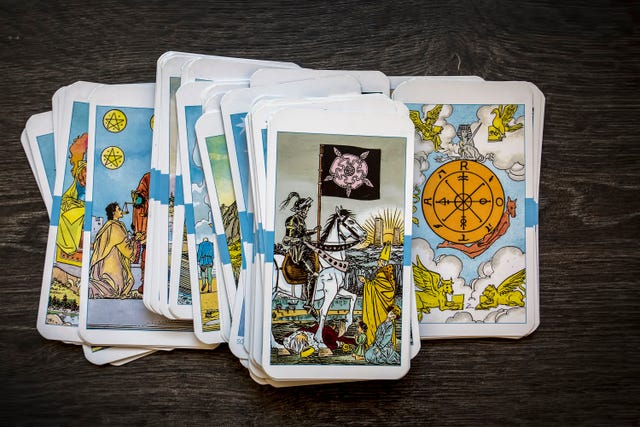
Tarot History

Ok so in today’s society tarot decks have become synonymous with mysticism, fortune telling, and the new age spiritual movements, but where did they come from and what were they originally used for?

Tarot Tutorial: A Deep Dive Into Tarot Decks
A Modern Rider Waite Deck

First and foremost, originally Tarot decks were not used for telling fortunes but were in fact a normal deck of cards for playing games. The four suits we know and love on playing cards today – hearts, clubs, diamonds and spades were originally the four suits most associated with Tarot – batons, coins, swords and cups. These were used by Italian aristocracy to play games not unlike bridge. This type of game seems to have originated in the 1300s and then in the 1400s there is evidence of decks which had extra “trump” cards which were illustrated non-suit cards. These, therefore, could be seen to be the very first tarot decks, although it is likely that they were simply an extension of the card games played with the original cards. By the fifteen hundreds, these types of cards were being used to play storytelling style games where the cards were turned and a story, poem or rhyme had to be constructed around its meaning. It is quite possible that this began to give rise to “Playful Divination” – making up playful fortunes for each other based on the cards which fell.

Tarot were not the first form of fortune telling with cards. In fact this does seem to go back to the 1600s with decks such as the below being used. (Image courtesy of the British Museum and used under their copyright statement – not to be used for commercial purposes). Fortune telling with cards is called Cartomancy. This includes tarot as well as any other type of card-reading. (some people still use traditional playing cards to read fortunes these days as well as other variations on the theme.)

Divination cards from the 1600s

Despite this, whilst most people presume tarot reading to be an ancient art, in fact historically the very first mentions  of tarot specifically for fortune telling were not until 1750! By 1789, tarot decks for cartomancy were being created. Antoine Court de Gebelin – a French freemason – published a complex analysis of the Tarot in 1781 where he claimed that their meanings were from the Book of Thorth, (A group of texts said to be written by Thorth, the Egyptian god of writing.) This is an unsubstantiated claim, however it is the basis for Alistair Crowley’s Thorth Tarot which was developed in the early twentieth century. Ten years later a man named Jean-Baptiste Alliette, another Frenchman who was also an occultist, released the first Tarot deck designed specifically for divinatory purposes, rather than as a game or entertainment. This was heavily inspired by the work of Gebelin before him.

The Ryder Waite Deck – which was to become perhaps the most well-used deck in modern times was not developed until 1909, previous to that, the old French decks were used such as the Marseille deck pictured below.

A modern version of the Marseille Tarot Deck

The rise of Oracles

An oracle deck differs greatly from a tarot deck. It is a deck of cards, but it has no suit cards (Minor Arcana) and does not conform to set Major Arcana cards like tarot. Most tarot will contain four suits and recognisable cards  - death, the high priestess, the wheel, the tower and so forth. Whilst some modern decks deviate from this and change the name of the suits, it is these traits which denote them a tarot deck rather than an oracle deck. The popularity of Oracle decks has grown exponentially in the last half a century, often embraced for its lack of rigidity and it’s free-flow story telling. Unlike Tarot, Oracle decks have no suits, and are just a series of images.

As to origins, the term Oracle comes from ancient Greek. The ancient Greeks believed that man could communicate with Gods at certain times, at specific places and through certain gifted persons or mediums or Oracles. There is no mention of cards ever being part of that equation though! In fact, Oracle cards in the form people understand them today are a very new occurrence! They do however have roots as old as the tarot sets which were being used in the early 1800s.

Some of the earliest oracle decks seem to have been variants on tarot decks. Mlle Le Normand – a fortune teller from the mid 1800s, designed her own deck but rather than use the traditional major arcana (the “trump” picture cards which do not have a suit) she instead drew up her own including cards

The Mountain - from
the Le Normand Deck

such as “the tree” “the snake” and “the cloud”. She also did not use the Minor Arcana suit cards in her deck. The cards such as her deck and several other similar ones from this era can be viewed in the British Museum Gallery. It is unknown whether La Normand was the first to design a deck like this, but certainly hers was an early one. It was actually not published and made popular after her death. There are other remaining cards from this era which were very similar so it would appear she wasn't alone in this practice.

For a long time this was considered to be the very first Oracle deck, however cartomancy expert Robert M Place has discussed an older deck - this deck is one named the Hooper Cards or the burning serpent deck. This deck was published in 1775 and shares many similar cards to the recognised Tarot deck we know these days – the hermit, courtship, Death, Courage and so on. It is likely an influence in early tarot decks or influenced by them. It also has a number of unique cards such as “the house on the hill” and “the cloud”, and no minor arcana (suit cards). 


For both Tarot and Oracle however, one thing is certain, fortune telling using such cards come to popularity in the Victorian era. This does seem to have faded to the background until the founding of Wicca in the 1950s, where it has came back to the forefront. The emergence of occultist thought and practice in the Victorian era probably has a lot to say about this, as does the rise of the spiritualist movement amongst Victorian ladies (see my blog post on that here!).