Dr. Grissea Fox (who also writes as Emma Barrett-Brown) is an author and historian from Plymouth, Devon. Here she presents bite-sized portions of local history, folklore, and so called "dark" history on her Official Blog.
I hadn’t heard of Holy Trinity Church in Buckfastleigh until a couple of years ago. I was scouting around for book promo shoot locations when someone said to me, “What about the ruined church in Buckfastleigh? You know, the one with the cage over the grave.” I didn’t know what they meant but, of course, I was intrigued. They gave me directions and I told my partner, Jay, to pack his camera!
So, off we went. We were doing the shots for one of my books and also a promo shoot for my business Alter Ego. The place is exactly the sort of backdrop you’d expect for gothic photos: scorched stone, roofless walls, and the tower still standing watch over the graves. It was spooky, yes, but also surprisingly quiet. We pranced around the churchyard with our props, snapping photos among the headstones, and every now and then I’d catch myself looking over at the famous tomb in the corner. It is one thing to read about a caged grave and quite another to stand next to it.
Me and Tabs - the bestie - at the church
So, the history. Holy Trinity was Buckfastleigh’s parish church from the fifteenth century right through into the twentieth. Over time the town grew down in the valley and a new church was built closer to the people, leaving Holy Trinity less and less used. Then in 1992 vandals set it on fire, destroying the roof and gutting the inside. Over the years locals have embroidered the story, some say it was Satanists, others whisper about occult rituals. It fits the pattern: once a place already has a “dark” reputation, people pile on extra layers of myth to explain any later misfortune. Either way, the fire was real and today the church stands as a hollow ruin, open to the sky.
And then there is Richard Cabell. Cabell was the local squire of nearby Brook Manor in the seventeenth century, remembered less for any great deeds than for being cruel, corrupt, and generally despised by his neighbours. He died in 1677 with a reputation so black that locals built him a chest tomb of heavy stone and caged it with iron rails. Cabell was said to be violent, corrupt and irreligious, a man people feared enough to try to pin down even in death. The legends followed quickly. Stories of phantom hounds circling the tomb on stormy nights, of Cabell’s spirit roaming Dartmoor, of how Arthur Conan Doyle supposedly borrowed the tale for The Hound of the Baskervilles. Whether or not Doyle ever did hardly matters now, because the link has stuck.
What I found interesting, posing there amongst the ruins with my bestie, is how much of the story comes not from words but from sight. The tomb (which we didn't actually photograph, would you believe!) looks like a stage set. You don’t have to be told Cabell was wicked; the iron cage tells you. Other squires have been forgotten, their names on fading stones, but Cabell’s story clings because there is something to see, something to point at. Even with the church gutted, the legend feels louder than the history.
So, Holy Trinity isn’t just a ruin, it is folklore made solid. A ruined church, a caged grave, and centuries of stories still circling. We went there for photos, but what I came away with was a sense of how a place can hold a story long after everything else has burned away.
My very first published novel, way back in 2014, was Ella’s Memoirs. It was a gothic tale that included witch trials, although mine were set in Germany where persecutions reached some of their most terrifying heights. You do not need to look abroad to find witches, though. Devon has its own story, and it came shockingly late. In 1682, three women from Bideford were tried for witchcraft and hanged. Their case is remembered as one of the last executions for witchcraft in England.
The women were called Temperance Lloyd, Susannah Edwards and Mary Trembles. They were all poor, marginalised, and vulnerable. Temperance had already faced accusations before, Susannah was widowed and socially isolated, and Mary had lost her family and survived by begging. In other words, they fitted the profile of women who were easiest to target when fear and resentment ran high (Callow 2021).
The charges themselves were built on flimsy ground. Local gossip claimed that Temperance had confessed to meeting a “black man” who gave her power, that she had pinched and cursed a neighbour. Other testimony accused the women of travelling in invisible form or leaving marks upon the afflicted (Barry 2012). The trial was held at the Exeter Assizes, in Rougemont Castle, under Judge Thomas Raymond. The jury convicted them, and they were executed at Heavitree on 25 August 1682 (Gent 1982).
What makes the case so striking is its timing. By the 1680s much of Europe had moved away from witchcraft prosecutions, and even in England most accusations ended in acquittal. Devon, though, put three women to death on little more than suspicion and prejudice. John Callow describes it as a “tragedy of sorcery and superstition” and reminds us that the intensity of hatred towards them is part of the reason their story was preserved when so many others were forgotten (Callow 2021).
Their memory lingers. Exeter now has a plaque on the gatehouse of Rougemont Castle naming Temperance Lloyd, Susannah Edwards and Mary Trembles, along with Alice Molland, another woman said to have been condemned for witchcraft in the region (Exeter Civic Society 2023). They are remembered not as villains but as victims, women whose lives were destroyed by gossip, fear and the readiness of the powerful to believe the worst of the powerless.
So, when I wrote about witches in my first novel, I imagined Germany. Yet the same story was happening here in Devon, with the same ingredients of poverty, fear, and prejudice. These women remind us how close folklore and tragedy can sit together, and how easily a story can become a sentence.
References:
Barry, Jonathan. Witchcraft and Demonology in South-West England, 1640–1789. Palgrave Macmillan, 2012.
Callow, John. The Last Witches of England: A Tragedy of Sorcery and Superstition. Bloomsbury, 2021.
Gent, Frank J. The Trial of the Bideford Witches. Bideford: Edward Gaskell, 1982.
For a couple of years I lived in Plymstock, not far from Radford, and it became one of my favourite places to walk my two dogs. The path leads you in under the trees, then down to the wide lake where swans and ducks float about on the still waters. On one side the ruined boathouse leans into the water, its roof gone, its windows hollow. Further along you find the folly castle standing guard on the bank, and in the middle of the grounds the remains of the old silo still rise up, a reminder of when the estate was more than just a park. It is a place where history shows through in fragments, every turn of the path hinting at what once stood there.
The only thing that ever spoiled it for me was the South West Water plant tucked on the edge of the park. If you wander too near on the wrong day the air turns sharp and sewagey, a rude interruption to the otherwise gothic air of the lake and woods.
Even so, I loved it, and I even used Radford for my books, sourcing the cover photographs for Ella’s Memoirs and The Black Marshes there among the ruins.
One of the raw images from the Haverleigh cover photos featuring Natasha Berry who posed as Ella.
The Ghost Stories
Radford has its share of ghost stories. A faceless monk is said to appear at the lodge gates. Drake himself is said to have been spotted there and people claimed servants' bells rang on their own in the long-ruined house before demolition. Dogs are said to shy away from the paths at night. The most famous of all is the White Lady.
The story of the White Lady at Radford is told in many ways. Most versions centre on a young woman of the family who drowns and whose ghost lingers by the water. First to mention is that "White Lady Ghosts" are a common figure in folklore, not just in Devon but across Europe. They are usually tied to stories of tragic love, suicide, or betrayal, women who died too soon and are said to wander in pale garments near the place of their death. The details change from place to place, yet the image is instantly recognisable. I have written before about the White Lady of Berry Pomeroy Castle, and you can read more about the whit ladies of folklore in my earlier blog post HERE
In one of the best-known tellings of Radford's white lady story, a girl of the house falls in love with a boy from Oreston. She is forbidden to see him, and the pair take a rowing boat onto the lake which overturns, drowning them both. Since then she has been seen in white, walking by the water or drifting across it on moonlit nights, searching for her lost love. A local road even bears her name, White Lady Road, keeping the tale alive.
I have come across several variations of this tale too, from blogs and heritage sites to Facebook posts and other retellings. The details shift with the teller. Sometimes the companion is a sweetheart, sometimes a close female friend of lower rank. Sometimes the lady drowns by accident, other times she chooses to end her life. A few versions move the setting away from Radford altogether and place her death at Hooe Lake. These contradictions are typical of folklore like this.
Radford House was once the great seat of the Harris family, rising from a medieval manor into a grand Elizabethan mansion where Sir Christopher Harris, Member of Parliament for Plymouth and close associate of Sir Francis Drake, entertained figures tied to England’s naval exploits. Drake is said to have lodged at Radford during preparations against the Armada, and the Harris family held his will for a time, securing Radford’s place in that circle of sea-faring legend. The estate sprawled across what is now Radford Park, with ornamental gardens, a lake, a boathouse and, later, a little folly-castle built on the dam. By the nineteenth century the land was being parcelled and remodelled, its former grandeur slowly ebbing away. The twentieth century brought decline: the house stood increasingly empty, its contents sold, its walls left to rot, until the main building was finally demolished in 1937. What remains today are fragments: the lake, the lodge, and the boathouse ruins which are open and free to roam.
In several recountings of the folklore, I found mention of the white lady's drowning happening in the 1700s (18th century). In the 18th century there certainly were daughters and female relatives living at the house such as Susannah Harris and Anne Harris of the Bellevue and Hooe branch. Neither of these ladies drowned, though. In fact, after extensive searching through parish registers, inquest files, and local papers, I can confidently say that there is no record of any drowning there in the period usually implied by the legend. No named young woman lost to the water. No grief-stricken lover. Nothing of the sort.
There was, however, one incident that may have seeded rumour from a later period. In 1853, a twenty-year-old woman named only as "Mrs Revil" was discovered in Radford Lake with her baby in her arms. She and the child had both almost drowned, but ‘had the good luck’ to be pulled out by a passing doctor, who managed to revive them both. Mrs Revil lived not in Radford, but in Prince Rock, and had no recorded link to the house. Her actions were reported as an attempted suicide and attempted murder of the child in the Western Times (25 June 1853, p.7). The story travelled widely, reprinted in several newspapers across England, including in London. It is tragic, sensational, and close enough to the setting that later retellings may have shaped it into something ghostly.
More telling still is the silence in the literature. I cannot find any written version of the Radford White Lady prior to a local guidebook in the 1990s. The most-cited online account is an unsourced ghost story book printed in 2010. The demolition-era reporting (for example, Western Morning News, 27 July 1935, p.7) describes the house falling into ruin. It speaks of echoes of Drake and of bells heard on still evenings, but no pale figure by the lake. Those latter details seem to have grown later, perhaps from oral stories told around the time when the estate was derelict and romantic to imagine.
So the White Lady of Radford is both ghost and gap: a figure who may never have lived at all, yet whose presence has outlasted those who did. Walking the water’s edge at dusk, I can see why she has appeared as a local legend.
Bowden House stands just outside Totnes in the parish of Ashprington, a building with layers of history written into its very walls. A manor has existed here since at least the medieval period. In the early 1500s John Gyles built a grand Tudor house on the site, complete with carved chimneypieces and panelled interiors. A century later, in 1704, Nicholas Trist purchased Bowden and transformed it, refacing the Tudor core in the elegant Queen Anne style that still dominates its south and east fronts. By the 1800s the Adams family (not the spooky one!) had taken over, leaving their own mark on the fabric of the house. Today, the Grade I listed property is home to the Bowden House Community, an intentional eco-community that has lived there since 2005.
(image taken from wiki)
That’s the official history... but there’s another side to Bowden’s story, one that’s almost been lost.
So, I was working on my Conversations About Ghosts project, when a story led me to research a location close to the house. This started a stirring... I had this nagging feeling - this buried memory. I was SURE the house ran ghost tours back in the 1990s! Proper guided walks, with glossy little leaflets stacked on tourist stands alongside Paignton Zoo and Crealy Adventure Park. I could see the leaflets in my head, remember the talk of hauntings, but when I searched online there was nothing. Not a word. It started to feel like a false memory, one of those odd tricks where you’re sure something happened, yet everyone else looks at you blankly. It was odd!
I didn't think about it again, then, but just recently, I was writing up some history and background for the book and, since I had a free afternoon, I decided to give it a deep dive. At first, much of the same... that being, nothing at all. Then, at last, I stumbled across a post on an obscure Fortean forum where someone described the very tours I remembered. Right down to the details. The relief of knowing I hadn’t dreamt it was immense. Even better, I eventually unearthed newspaper clippings from the early 90s confirming the tours had been real.
According to those old reports, visitors claimed to have seen ghostly monks chanting in the dead of night, Elizabethan figures drifting through the halls, and the famous “girl in blue” on the staircase. Others spoke of invisible dogs brushing past their legs, cold hands tugging at their clothes, and even a disembodied arm floating across the lounge. Guides in Georgian costume led groups room by room, keeping a sightings book of every chilling account.
Proof at last. I knew it.
What strikes me now is how little trace remains. For a while Bowden was painted as one of the most haunted houses in Devon, with stories of dozens of different ghosts drifting through its corridors. Now there is almost nothing. Apart from those buried newspaper articles and that single forum thread, it’s as though the ghost tours never happened. Maybe they ended when the house became a community in 2005, or maybe they were just a short-lived 90s curiosity that faded quietly into memory.
Hauntings often flare up in the public imagination and then fade away again like this though. In the 1930s, for example, Borley Rectory (in Essex) was everywhere in the newspapers, branded the “most haunted house in England.” but but after a fire and years of scepticism it faded into obscurity. Whilst those of us who are interested int he topic still know the name, there are no recent stories. In the 1970s and 80s Chingle Hall (Lancashire) was drawing crowds for its ghost tours until the doors shut and the stories fell quiet. Even Pluckley in Kent, once promoted as the “most haunted village in England,” has slipped into relative obscurity after years of ghostly fame. Bowden House seems to follow the same pattern. For a short time it was a place of leaflets and late-night whispers, before vanishing almost completely from memory. Its haunting, like so many others, was not just about ghosts but about the way we remember and forget them.
Today's post contains not only some Tudor history and some local history, but some ghost stories too! I really am spoiling you!
Most people reading this will have heard of Henry VIII and his infamous 6 wives! Most will even be able to name those poor unfortunate ladies - Katherine of Aragon, Anne Boleyn, Jane Seymour, Anne of Cleeves, Catherine Howard, Katherine Parr - but what some of you might not know is that one of the most famous stately home castles in Devon was actually owned by Jane Seymour's brother!
Berry Pomeroy Castle sits out in the countryside between Paignton and Totnes on the edge of Berry Pomeroy village. The place is atmospheric and set into some of the most beautiful countryside I have ever seen. Sadly, however the house stands in ruins these days and was in fact not actually ever finished in the first place! Here's a pic I took last time I was there...
Berry Pomeroy Castle, taken in between lockdowns 2020 by myself, Dr Emma Barrett.
Berry Pomeroy's origins are interesting. Originally, the house or at least parts of it were thought to be of Norman origin, however it's been discovered recently that in fact whilst the Pomeroy family was present in the village in that era, they actually lived in a smaller mansion near tot he church! The original structures, then were more likely built in the late 1400s by Henry Pomeroy or his heirs. The distinctive house within - as seen in my pic above, was actually built much later. Edward Seymour, the Lord Protector of England (Uncle of Henry VII's surviving son and brother tot he late Queen Jane) bought the land and buildings on it in 1547 during a time where he was in high favour and was buying up fancy houses throughout the country. Whilst Berry Pomeroy was the most valuable asset he acquired, there is no evidence that he did anything to the mansion himself - especially due to his soon thereafter downfall and execution. (Jane Seymour's brothers fell from grace quickly with both Edward and Thomas being executed within about ten years of each other! Thomas is also an interesting character having married Henry VIII's widow Katherine Parr in secret - but that's another story for another time!)
After Edward was executed, the house passed down to his heirs rather than revert to the crown, and it was his son who first settled there and began an ambitious plan to build a huge stately home there. Alas, he ran out of cash before he was done and so Berry Pomeroy was never completed! Despite that, the land and the ruin within are still owned by the Seymour family to this day. For a more in depth account of the history of the house, the current caretakers - English Heritage - have a great blog post on it and rather than just repeat that, I suggest that you have a look at that HERE
I first encountered Berry Pomeroy a lot earlier in life than my love of history, though! When I was younger, I began to collect Ghost Stories from people with a view to writing a book (a project 25 years in the making and still ongoing! See HERE for more info on that! ) and being local to Totnes of course I heard a lot of stories about Berry Pomeroy (these will be in the book if I ever finish it!). From ghostly figures in the woods, to spectral children Berry Pomeroy has earned it's reputation as one of the most haunted sites in Devon! I've actually visited the place many a time myself - as a younger woman looking for ghosts and as an older one just to enjoy the peace and ambiance! Below is a pic of me and one of my close friends posing for an atmospheric photo at the last visit!
Myself (Dr Emma Barrett) and a friend Miss Tabitha Shave at the ruins
Now, I tend to take the middle road with ghost stories I am open-minded but also quite skeptical - I love to hear about experiences and have experienced some weird (but probably explainable) phenomena myself, but I do take a lot of ghost stories with a pinch of salt. Berry Pomeroy is a fine example of that. One of the most repeated and recognised stories is that of The white and Blue ladies of the castle.
"The White Lady is the restless soul of Margaret Pomeroy. She haunts the dungeons of St. Margaret’s Tower and has been seen waving to visitors. She was held captive in the castle dungeons by her sister, Eleanor, because of jealousy and starved to death in the dungeons"
A ghoulish though indeed. Whilst I have chosen this quote - this is a very common tale about the castle and I have heard similar told to me accompanied by apparent sightings. (as in "I thought I saw the ghost of Matilda / Margaret De Pomeroy... then launch into the story).
HOWEVER! It's not true!
In the 1800s, the castle ruins became a haven for artists and writers during the romantic movement and of course the castle was perfect as the setting for a gothic novel! In 1806, a writer by the name of Edward Montague wrote a spooky gothic novel using the castle as it's base. His novel featured the fictional Elinor De Pomeroy and her sister Matilda. Elinor, jealous of her sister marrying the man that she loved, had her murdered. The sister's ghost then began to appear as a white lady around the castle to bring attention to her sister's nefarious deeds! Sound familiar? Probably because it is very likely that this novel forms the basis for these particular tales!
Further to this, however - I have also seen people claiming that the book is based on real events, some say from the medieval period, others say from the 1700s... the latter is very unlikely as the house was a ruin far before then!
As to a medieval source, firstly, Elinor De Pomeroy seems never to have existed! There is some evidence that there may have been a lady called Matilda De Pomeroy - in fact her full name was Matilda “Maud” De Vitre De Pomeroy. However Matilda was not a daughter of the house, but was in fact married into the family as the wife of Henry De Pomeroy in the 1100s. As we have seen by the above history, this means she actually never set foot on the grounds of the castle as it is known now, and would have resided at the previous smaller mansion nearer the village. Matilda did indeed die young, most likely in childbirth or shortly after from the dates given for her only son's birth, however that is about all that is known about her!
To add to this, the idea of a "white lady" ghost is actually a staple of many folk-lorish ghost stories all around the world - thought to be the spirits of the murdered, suicides or those who have died at a time of unrequited love. It is more likely, then, that Montague based his white lady ghost more in this sort of folklore than actual events.
The second most famous spirit said to haunt Berry Pomeroy is the fabled "blue lady" and she seems to originate from the 1700s. In the 1790s, a memoir was published by a rich doctor (Dr Farquar) who told a tale of a woman roaming the village of Berry Pomeroy who he considered to be a reliable harbinger of local deaths. Not a living woman, but a ghost of some poor unfortunate. Dr Farquar's story seems to be the first instance of this ghost story coming to light, with later retellings moving to describe the woman as dressed in blue. This then morphed into sightings at the castle, and then finally to her as a spectre which led the unwary to their deaths in falling from one of the towers. In many ghostly blogs the blue lady of Berry Pomeroy is stated to be that of a woman who lived in the Norman castle and who murdered her incest-conceived child. This is of course, debunked by the history, since the castle did not stand in Norman times. Also, noteworthy, incestual relationships are another staple of Gothic Literature (the Castle of Otrano springs to mind, by Warpole - which is said to be the first true gothic novel), and so it is likely that this story too is the product of over stimulated gothic imagination!
Hello all! As some of you will be aware, I am (and have been for some time) working on a creative non-fiction book about local ghost stories called "Conversations About Ghosts" and I would like to share a ghost story from that collection with you as well as some of my research surrounding it. This story was told to me by my mother, and was one of her "real life" experiences. Here's the story:
‘When I was a fair bit
younger than I am now, and pregnant with my second to last. Me and M (her
ex-husband) decided to take Rex – my old collie –
for a walk up in the countryside behind the house. It was late in the afternoon
but it was summer so we set out into the fields with our picnic and a book
each. We were still fairly newly married at the time, with baby on the way. I didn’t want to walk too far so we stuck to the fields opposite the house
and then settled down in the grass. I guess my mum had the other kids as it was
just me and M. Rex didn’t need a lead as there were no sheep or anything around so
we just let him off to explore and play - irresponsible, maybe - but we were young and it was normal for us when walking him. We stayed in the fields which run
alongside the lane until evening began to really creep in, when the air got
more chill we decided to call it a day and packed up our things. I called Rex
back from the other end of the field by a gate where he was sniffing about... but he didn’t come. I called again and nothing - then he started to
bark, deep and booming, growling barks. Now, Rex was a really friendly dog! He
never barked aggressively (although being a collie, excited barking was a
different matter). This sounded fairly threatening though and so, embarrassed,
I ran up to grab him. The naughty thing was at one of the stiles which go over
into a lane behind, and when he saw us coming he jumped over the short fence. I was
astounded, this was so out of character! He was normally such a good dog
but he was obviously really wound up. M and I ditched our bag by the stile, I climbed
over into the lane to grab the dog and M followed. There, we were surprised (and initially somewhat
relieved) not to find a person or perhaps another dog as the object of Rex’s
ire, but in fact a very small and compact patch of mist.
Then confusion rose
again.
Why on earth was the stupid dog barking at mist? So, I was a bit spooked, I won’t lie. The lane is very spooky anyway, deserted with not a house in sight, just tall hedges and countryside. This wasn’t the first spooky thing I
have seen in my life,but it was just odd and weird and I was pregnant and tired and not in the mood.
I looked at M to see he seemed to share my feelings, lips pressed and eyes wary.
I called firmly to Rex who was, just by the way, on the other side of the damn
mist. He ignored me. Completely. We tried walking away and calling him but he
just stayed, ‘ruprupruprup’ a few growls, then back to the barking. In the
whole time I’d owned him, I’d only ever seen Rex do this once before, and that
was when M and I had had a big row and he’d got between us. Even then, he’d
not growled, just barked, so this was a whole new experience. As I looked at the mist too, I got a weird feeling about it. It kind of looked a bit like a person's outline, a man - taller than me - definite head shape, but with a undefined body and then tapers which looked like arms and legs. Even as I stood puzzling on it, M put a hand on my shoulder - I physically jumped - right out of my skin. 'Annie,' he said, 'does that... does that look like a person?' I was glad he'd said it first. I said nothing but managed to nod. It was right next to us, not moving - still and normal, but with my dog barking madly on the other side. 'I'm going to have to get him,' I said, but I was still reluctant to touch the misty figure. I wet my lips and then suddenly, I stepped forward and grabbed the dog's collar. It was like walking into a freezer! I started shivering almost in the - what - 2 seconds I was in there? I grabbed for the dog and I managed to get him and then I tell you, I was over that stile in a second and gone!
And that was her story, a story she told over and over again! Now, I am sure, like me as a young skeptic that I was, you are probably thinking "come on, that was just mist", but even if it was, my mother wasn't the only person to tell me a story about that exact same place! (you'll have to wait for the book to hear the rest!) Let me show you my little map from my notes...
On the graphic included above, points A to E are places where the stories I have gathered about this lane are said to have happened, to the best of my knowledge from piecing it together from the stories. There is also a missing point F and G because I am unsure where exactly in the lane these encounters happened. So straight off the bat, there seems to be a lot of ghost stories originating about this same lane.
In part, this can be put down to the fact that stories travel - especially on little estates like ours, and the lane is very quiet and eerie, especially in early morning or at twilight! It would only take a person to hear a story such as my mothers and then find themselves alone walking their dog as the sun is dipping to start to feel that chill on your spine. Having walked it myself many a time, I can tell you that both sides of the lane are set in by tall hedges with only the occasional gate to break the trees. As my mum described, there were no houses really anywhere close by it, aside from an old place called Butteville House (built 1820s) just on the edge of the lane. It’s a popular spot for both hiking and dog walking as no cars are allowed up it past Butteville.
The picturesque Buttville House, Kingsbridge, alongside which the lane runs. Image from Strutt and Parker Estate Agents
The floor is uneven, some old broken cobbles still remaining here and there but mostly mud and stones. It runs for a good mile, before splitting into two parts, one of which returns you to the housing estates, the other which snakes off towards the now modern road to the next village. As far as I can gather, Mum and M were in the first part of the lane, still, before it broke into two.
"But this is a history blog, Emma!" I hear you shout, "so let's do some history!"
Ok! Let's do some history! A quick glance at some old maps shows me that the "lane" is actually all that remains of the old road from my hometown to another little village nearby, although it no longer goes that far. The first thing that is interesting is that whilst the "lane" proper seems to have been a road, the offshoot looks more like it was a footpath and went a slightly different way. This holds up to walk it as that part of the lane is much narrower and meets a modern road which did not exist then.
This is from the 1886 Ordinance Survey
By 1938 however, the roads on the map were then labelled with road names, however "the lane" - whilst marked, is not named, therefore leading me to believe that sometime between 1886 and 1938 this road fell into disuse!
A theory put about in local myth and told to me at least twice was that it was a condemned man making his last walk to the gallows, however since there never was a gallows in Kingsbridge along this road, that can purely be put down to myth! I did look a little further into this just in case, using internet newspaper archives. Turns out there was only one instance of highway robbery reported in the town and it was on a completely different road. Searches for Butteville and Buttville came up with only births and deaths at the house! There was an unexpected death at nearby Washbrook Mill in 1899, however it was an elderly woman who died after feeling unwell rather than anything nefarious. No accidental deaths were even recorded on the road!
And so all leads came to nothing!
This is the part of doing this sort of research that the spooky ghostly documentaries and "ghost hunter" shows never tell you - I'd say 90% of my research into these sorts of hauntings lead to nothing when you start to explore the history - of course the older a building or place, the more likely it is to throw up something relatable, but not always! This was one of those cases. So, why are so many people experiencing weird phenomena on an apparently unremarkable road? Who knows!
This piece is an article I wrote for the 2019/2020 "Wonky Broomstick Diary".
As
you are walking out in the lushest part of the greenest forest you can imagine,
a figure catches your eye. He’s like nothing you’ve ever seen before, cloven
hooved, ancient eyes and ears which poke up out of his hair like an animal. He
has horns like a goat and eludes a feeling of ancient wisdom, interspersed with
playfulness and raw animalistic power. In his hand, he carries a musical
instrument: a set of pipes made of reeds, and all about you, you can hear the
sound of the leaves swishing so that they sound like the laughter of young
women. You might well have just stumbled into the realm of the god Pan!
Pan
is a well-known figure in modern paganism, known for his half-goat form and
iconic “Pan pipes”.
This article will give you a run-down of where he originated, and how he had
risen to become such a well-known deity.
Pan
was first mentioned in ancient Greek mythology. He was first worshipped in the
region of Arcadia as far back as the 4th century BCE where he
was heralded as the god of mountain and pasture. From there his image spread
throughout Greece but whereas most of the Greek gods were worshiped at temples
or shrines, Pan was rarely approached in this way, and was more often worshiped
out in nature. Pan was thought also to be a close acquaintance (drinking
buddy!) of Dionysus, the Greek god of festivity and wine, and there are several
stories in the mythology about their antics! In Roman mythology, there is
another remarkably similar god named Faunus and in modern understanding of Pan,
some of Faunus’s traits have been incorporated, and some believe that he might
well have been a cultural representation of the same god. Faunus, like Pan, was
an animalistic god, being also half-goat and half man. In Roman terms, this
amalgamation is a faun, named for Faunus, and in Greek terms it is a satyr.
Both terms are nowadays used interchangeably. Both Faunus and Pan share the
traits of being the god of pasture, mountain and fields, as well as having
something of a reputation as erotic and sometimes lustful gods! There is
ongoing debate still, as to whether Pan and Faunus are the same god, brother
gods, or unrelated, however the stories told of them are remarkably similar!
Pan is, in general, seen as a happy-go-lucky sort of a chap! He was especially
fond of Nymphs and is often referred to in conjunction with these creatures,
quite literally! He is often portrayed as erotic, and many of the stories about
him include some level of romance or sex – usually with nymphs although that is
not unusual for a forest god, one would imagine! He drinks, sings, dances and
frolics about the forests.
Despite
his jolly and frivolous nature, some of the stories of Pan show his downfalls
too, as he is often described as too hedonistic and unthinking in his pursuit
of pleasure! One of the most famous stories of Pan is that of how he
forged his pan-pipes:
Deep
in the forests at the foot of a row of ancient mountains, there lived a wood
nymph named Syrinx. Syrinx was the most beautiful of wood nymphs, with rich
long hair and eyes which flashed with playful intrigue. She lived happily and
was sister to the river nymphs of a nearby body of water. Pan, who walks all
mountain paths and pastures, happened into
Pan and Syrinx by Edmund Dulak
Syrinx’s forest. The day was bright
and lush, with the sunshine creating reflections on the water, and the scent of
wildflowers in the air. Pan’s footsteps took him from the path, and towards a
rushing waterfall nearby. There, he caught sight of Syrinx for the very first
time, washing her thick and luscious hair in the waterfall. At once was taken
by her beauty and her playful manner. She smiled, and he was lost – madly in
love with her in the blink of an eye! Pan moved in closer as she sat out on the
rocks, naked as nymphs are, and made a motion to speak with her, to entice her
to come to him as so many of her kind had before. Syrinx, however, knowing of
his reputation and unwilling to be the next in line of his conquests, jumped up
at once and fled into the woods. Pan, thinking this was some game – for nymphs
were known to play such – took off after her, laughing and enjoying the fun of
the chase. Realising
that Pan pursued her, Syrinx ran to her sisters, the river nymphs, and asked
them to hide her from Pan, so that he would pass on and be about his business. The river nymphs
did so, turning her into a reed on the edge of the river. Seeing this, Pan fell
to his knees and begged the river nymphs to turn her back so that he might
speak with her, but they – being scatty as nymphs often are – did not know the
magics to undo the spells and so were unable to turn Syrinx back. As the days
passed, the reeds that had been Syrinx melded in with the others which grew
upon the banks of the river, wilting and rising again so that she became lost
there. Pan mourned for long days at the side of the river, but as he sobbed,
his breath cast over the reeds, sending out a song so mournful and beautiful
that even the river nymphs themselves wept to hear it. Pan, in desperation that
Syrinx not be lost, as well as in remorse for his unwitting participation in
her downfall, cut seven reeds from the riverbank, and there he bound them
together to become what is known as the Syrinx Pipes, or as they are more
commonly known, Panpipes.
There
are some slight variations to this tale, in some cases it is Zeus himself who
turned Syrinx into a reed, and refused to turn her back in his annoyance at the
nymphs and their games – something of a cautionary tale for young girls! In others Pan was said to have raped the nymph, or have tried to.
Despite this and other such pieces of folklore about him, somewhat unusually
for Greek mythology, Pan doesn’t really seem to have a role in the god-politics
of the time. Other than being the guardian of pastures and fields, he didn’t
really have a role, spent no time involved in the usual antics which went on
around Mount Olympus and did not engage with the power struggles with which
Greek mythology is littered. Due to this, there are some scholars who believe
that Pan actually predates Greek mythology and was incorporated into their
stories as an outside agent. This debate has led to various theories about
Pan’s origins, with some scholars claiming that he could be one of the oldest
gods in existence, or even the original horned god, and that the Greek version
of Pan is just another interpretation of him. I even read one article where Pan
was cited to be possibly another aspect of the green man!
Whatever
his origins, Pan has become a household name in witchy and pagan circles.
Nowadays, rather than the god of pastures and fields, Pan is considered the
shepherd between civilised life and the wilds, and in some cases, the guardian
of the gate to faerie or other worlds. Pan is used most often used to represent
sexual frenzy – not fertility or love, but raw lust and passion. He represents
the inner self, the animalistic and primal self which follows hedonism and
indulgence. He is said to control primal urges and one article even named him
as the inventor of masturbation! In modern-day worship, Pan is still mostly
worshipped out of doors, and can be called upon to strike passion and lust into
your magics, rituals and circles. He can guide the mind away from the normality
of civilised life, and allow you to step back to a more wild and unfettered
state. Be wary though, as he is often set on his own pleasures, and has a
reputation for carelessness with other beings!
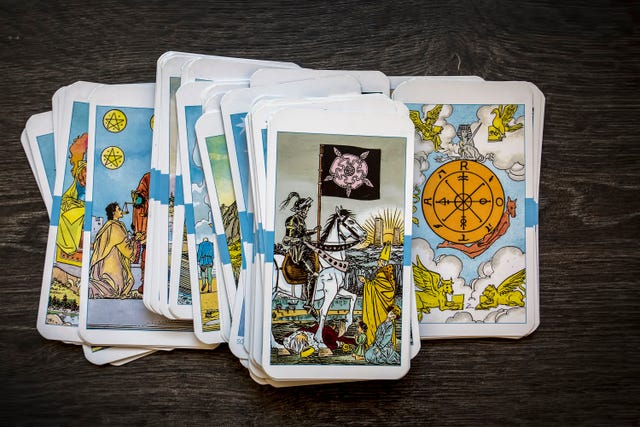
Ok so in today’s society tarot decks have become synonymous with mysticism, fortune telling, and the new age spiritual movements, but where did they come from and what were they originally used for?
A Modern Rider Waite Deck
First and foremost, originally Tarot decks were not used for telling fortunes but were in fact a normal deck of cards for playing games. The four suits we know and love on playing cards today – hearts, clubs, diamonds and spades were originally the four suits most associated with Tarot – batons, coins, swords and cups. These were used by Italian aristocracy to play games not unlike bridge. This type of game seems to have originated in the 1300s and then in the 1400s there is evidence of decks which had extra “trump” cards which were illustrated non-suit cards. These, therefore, could be seen to be the very first tarot decks, although it is likely that they were simply an extension of the card games played with the original cards. By the fifteen hundreds, these types of cards were being used to play storytelling style games where the cards were turned and a story, poem or rhyme had to be constructed around its meaning. It is quite possible that this began to give rise to “Playful Divination” – making up playful fortunes for each other based on the cards which fell.
Tarot were not the first form of fortune telling with cards. In fact this does seem to go back to the 1600s with decks such as the below being used. (Image courtesy of the British Museum and used under their copyright statement – not to be used for commercial purposes). Fortune telling with cards is called Cartomancy. This includes tarot as well as any other type of card-reading. (some people still use traditional playing cards to read fortunes these days as well as other variations on the theme.)
Divination cards from the 1600s
Despite this, whilst most people presume tarot reading to be an ancient art, in fact historically the very first mentions of tarot specifically for fortune telling were not until 1750! By 1789, tarot decks for cartomancy were being created. Antoine Court de Gebelin – a French freemason – published a complex analysis of the Tarot in 1781 where he claimed that their meanings were from the Book of Thorth, (A group of texts said to be written by Thorth, the Egyptian god of writing.) This is an unsubstantiated claim, however it is the basis for Alistair Crowley’s Thorth Tarot which was developed in the early twentieth century. Ten years later a man named Jean-Baptiste Alliette, another Frenchman who was also an occultist, released the first Tarot deck designed specifically for divinatory purposes, rather than as a game or entertainment. This was heavily inspired by the work of Gebelin before him.
The Ryder Waite Deck – which was to become perhaps the most well-used deck in modern times was not developed until 1909, previous to that, the old French decks were used such as the Marseille deck pictured below.
A modern version of the Marseille Tarot Deck
The rise of Oracles
An oracle deck differs greatly from a tarot deck. It is a deck of cards, but it has no suit cards (Minor Arcana) and does not conform to set Major Arcana cards like tarot. Most tarot will contain four suits and recognisable cards - death, the high priestess, the wheel, the tower and so forth. Whilst some modern decks deviate from this and change the name of the suits, it is these traits which denote them a tarot deck rather than an oracle deck. The popularity of Oracle decks has grown exponentially in the last half a century, often embraced for its lack of rigidity and it’s free-flow story telling. Unlike Tarot, Oracle decks have no suits, and are just a series of images.
As to origins, the term Oracle comes from ancient Greek. The ancient Greeks believed that man could communicate with Gods at certain times, at specific places and through certain gifted persons or mediums or Oracles. There is no mention of cards ever being part of that equation though! In fact, Oracle cards in the form people understand them today are a very new occurrence! They do however have roots as old as the tarot sets which were being used in the early 1800s.
Some of the earliest oracle decks seem to have been variants on tarot decks. Mlle Le Normand – a fortune teller from the mid 1800s, designed her own deck but rather than use the traditional major arcana (the “trump” picture cards which do not have a suit) she instead drew up her own including cards
The Mountain - from the Le Normand Deck
such as “the tree” “the snake” and “the cloud”. She also did not use the Minor Arcana suit cards in her deck. The cards such as her deck and several other similar ones from this era can be viewed in the British Museum Gallery. It is unknown whether La Normand was the first to design a deck like this, but certainly hers was an early one. It was actually not published and made popular after her death. There are other remaining cards from this era which were very similar so it would appear she wasn't alone in this practice.
For a long time this was considered to be the very first Oracle deck, however cartomancy expert Robert M Place has discussed an older deck - this deck is one named the Hooper Cards or the burning serpent deck. This deck was published in 1775 and shares many similar cards to the recognised Tarot deck we know these days – the hermit, courtship, Death, Courage and so on. It is likely an influence in early tarot decks or influenced by them. It also has a number of unique cards such as “the house on the hill” and “the cloud”, and no minor arcana (suit cards).
For both Tarot and Oracle however, one thing is certain, fortune telling using such cards come to popularity in the Victorian era. This does seem to have faded to the background until the founding of Wicca in the 1950s, where it has came back to the forefront. The emergence of occultist thought and practice in the Victorian era probably has a lot to say about this, as does the rise of the spiritualist movement amongst Victorian ladies (see my blog post on that here!).
Victorian spiritualism was a movement built on the notion that the dead could be communicated with via the work of mediums. The movement was unusual for its time, in that it was led by women, its meetings were majoritively attended by women, and in many cases women conducted these meetings alone, out from under the watchful eye of their male counterparts.
I do feel I need to define that this article is specifically about the rise of the spiritualist mediums movement, and is not about a modern tongue terms "spiritualism" in general. Those are very different things, as ever - language evolves and takes us with it! This article also does not debate or deny the existence of mediumship, spiritualists or the feats they were able to perform. That is a very well-done and tired debate that I do not have the space or inclination to get into :) Instead, this article is a quick overview of the beginnings of Victorian Spiritualism and its links to early feminism.
Origins: The spiritualist movement first began in America in the late 1840s with the fame of two sisters who claimed to be able to communicate with a spirit which rapped on tables to answer questions. These women, known as the Fox sisters, became the first famous mediums in America, after they claimed to be able to communicate with a dead murder victim. In 1852, another American medium, Maria Hayden, came to England and introduced Spiritualism to an English audience, where it soon became immensely popular.[1] During the 1850s and the following decades, there was a boom seen in the Spiritualist movement in England, from a few mediums trickling over from America in the early 1850s, to a massive amount of people practising many of its activities, such as table rapping and full-blown seances, in households and halls all over the country by the end of the century. This led too to the rise in scientific exploration of the supernatural, with the Cambridge ghost club being founded in 1851, this becoming the London Ghost club in 1882 which was the same year that the Society for Psychical Research (SPR) was founded by many of the same people.[2]
Background: For the average Victorian woman, life was often somewhat restricted by the social norms of the patriarchal society about her. This was especially true in the middle and upper classes. It was unusual for a woman to have any real power in her own life, or a voice outside of the home. [3]. A Victorian woman was expected to behave, to be polite and mild of temper, and to attend to the wishes of the men around her. Very few Victorian women owned property or businesses, nor did they run groups and societies other than charity work. (although some did - a side note, in my PhD research, I have come across several female asylum owners!) How much this stereotype was actually adhered to is debatable, but there is no doubt that the middle to upper class Victorian woman was one without very much agency in her own life.
Spiritualism in England: Spiritualism then, being brought over from America by female mediums, with tales such as those of the Fox sisters gave an opportunity for English woman to stand outside of her normal restrictive boundaries to step into a role which gave her a level of authority unusual for the time[4]. The rise of the spiritualist movement led to hundreds of ladies taking up mediumship all
over England, and thousands flocking to witness them. This was both a public spectacle, and a private one, with many people practising privately at home[5]. Georgina Byrne states in her research into the cultural implications of spiritualism, that outside of personal accounts and letters it is difficult to really examine private seances and spiritualist endeavours as these are generally not so well discussed or reported in media such as newspapers.[6] What is apparent though, is that there were many such seances and Janet Oppenheim discusses how it was more likely to be these private “Drawing room seances” which allowed the movement to really take hold in England.[7] The rise of the sciences too played their part in the popularity of spiritualism and here it is possible to examine how the gender roles might have been affected, as in general for the era, the sciences were seen very much as a man’s domain. Spiritualism fit well into the new scientific way of thinking, as it gave the hint of an afterlife which was perhaps more scientifically testable than that of religion.[8] It might be for these reasons, then, that despite that spiritualism allowed women to indulge in what were considered normally unacceptable feminine behaviours, the female mediums were given more freedom because what they were doing was interesting to the men studying the newly blooming fields of sciences. For the female mediums, there was also the opportunity to discuss such matters as science and religion, doing so through the guise of speaking for the spirits.[9] Again, this allows for the women to have more authority, in being able to discuss matters where normally they would not be expected to.
Male Mediums: The spiritualist publication entitled The Two Worlds printed in most editions a list of
“Mediums and Speakers” from across England. This list was maintained by self-referral and gave the name and address of contact. The magazine does stress that the list accuracy was maintained by the mediums themselves so there might be omissions, but still it gives an interesting insight into the prevalence of mediums willing to offer their services. In July 1887, 19 of the listed 101 mediums were unmarried women (as identified by the prefix “Miss”), 31 were married women working alone, 5 were both “Mr and Mrs” at the same premises and 46 were male. [10] This then shows that a great deal of women were taking part in mediumship, but also that a good proportion of the self-reported mediums were male. A year later in 1888, the figures were similar but with a rise in the proportion of males, with 18 unmarried ladies, 34 married ladies 4 couples and 56 men registered. What is also seen though, is that whereas female mediums operated at home, within their groups, the male mediums took the idea and altered it, making societies for scientific study and so on. In 1851, a group from Cambridge formed to investigate the supernatural. In their circular, they discuss how they hoped to “Earnestly investigate” the nature of supernatural phenomena, and offer a classification table with articles such as “Appearance of Angels” and “Spectral Appearances” of various kinds.[11] This group was known as the Cambridge Ghost Club, and founders were all male, indeed it was not until 1927 that women were permitted to join.[12] This trend seems to appear throughout the 1860s and 1870s, an article in the spiritualist in 1871 states: “The necessity of forming a psychological society to investigate spiritualphenomena, for the purpose of bringing the manifestations now socommon into the realm of law and order. As will be seen by thecorrespondence on another page, several highly intelligent gentlemendesire that such a society should be formed.”.[13]
Again, this shows the gender stereotype of the time, with the "gentlemen" being the ones to desire this scientific research. It can also be seen from examining the lists of members from smaller clubs, that these types of gatherings and clubs tended to be male-led. However, this was changing. In 1874, for example, in the July issue of The Spiritualist, there is a small advertisement for the Liverpool Psychological Society, who although not a spiritualist society do advertise as being in pursuit of the truth through means of psychology, and development of both mental and spiritual powers. The listed office bearer shows that several of the office bearers for 1874 were female. [14]
In conclusion then, it would appear that the spiritualist rise in England during the 1850s was fuelled by the women of the movement. They seemed to spread the word via peer groups and circles of acquaintances. The women who advertised themselves as mediums were predominantly married women, although the male population in the movement seemed to be growing. Despite a large amount of evidence which examines the public face of mediumship, there were also a large number of women practising the art at home, for reasons of self-enrichment, or even just for the fun of it. The fact that the women were the main instigators of the movement does challenge the gender roles of the time, as they were able to act in ways previously denied to them. This was due to the safety of the spiritual influence over them, which set them apart from the restrictions of normal society.
[1] Candice Gregory, "A Willing Suspension of Disbelief", Loloya University, 1989 <http://people.loyno.edu/~history/journal/1989-0/gregory.htm> [Accessed 19 April 2018]. [2] Georgina A Byrne, Modern Spiritualism and The Church of England, 1850-1939 (Woodbridge: Boydell, 2010), pp. 54 [3] Marlene Tromp, ‘Spirited Sexuality: Sex, Marriage and Victorian Spiritualism’, Victorian Literature and Culture (2003), pp. 67 4] Alex Owen, The Darkened Room (London: University of Chicago Press, 1989), pp. 199-205 [5] Georgina A Byrne, Modern Spiritualism and The Church of England, 1850-1939 (Woodbridge: Boydell, 2010), pp. 50-52 [6] Georgina A Byrne, pp. 52 [7] Janet Oppenheim, The Other World, 2nd edn (Cambridge: Cambridge University Press, 1988), pp. 8-12. [8] William H. Swatos, "Spiritualism as A Religion Of Science", Social Compass, 37.4 (1990), 471-482. pp. 475 [9] Marlene Tromp, ‘Spirited Sexuality: Sex, Marriage and Victorian Spiritualism’, Victorian Literature and Culture (2003), pp. 67-81 [10] Robert Dale Owen, Footfalls on The Boundary of Another World (Philadelphia: J.B. Lippincott & Co., 1860), pp. 513-515. [11] The Two Worlds, "Mediums and Speakers", 1887, p. 110. 12] Peter Underwood, The Ghost Club: A History, 1st edn (London: Limbury Press, 2010), p. 12. [13] The Spiritualist, "A Psychological Society", 1871, pp. 1-2. [14] The Spiritualist, "The Liverpool Psychological Society", 1874, p. 1.
Ok so as some of you may know from following my work, I have been writing a book of "true" ghost stories for about a million years. I'm still collecting stories so if you have one please do send me an email via the address on my profile :)
I have written an essay for the end of the book to discuss the concept of ghosts and ghost stories further. To add context, in my final year of my psych degree before I moved over to History, I decided to write my dissertation on the development of stories - more specifically ghost stories. In the end I did end up working on something a bit different (but still ghost related!). This essay began then and was tweaked, edited and perfected recently.
In her 2007 research paper on ghosts in folklore,
Jeannie Thomas made an assertion which I think is very relevant:
‘regardless of
what scholars assert, people will go on narrating anomalous experiences and
choosing to believe in either scientific or supernatural explanations.’[1]
This is basically stating
that no matter what researchers say, in the end people tend to have very strong
opinions about whether ghost stories have a scientific or supernatural cause,
but regardless of that, people will continue to tell them! And perhaps this is
the case. Paranormal experiences and beliefs are described generally as the
belief in, or experience of, phenomena which ‘violate basic limiting principles
of science’.[2]
That is, that they are outside of what would be considered acceptable if the
laws of science are adhered to. In 2009 this view was challenged by a researcher
named Irwin, stating that this definition is not adequate and that to dismiss
the study of paranormal phenomena is to dismiss any chance to further the
understanding of it.[3] It could be argued that these experiences and beliefs are
natural in cause, and that the current views and understandings of science are
simply not developed enough yet to add explanations. There is also an offshoot
of psychology called Parapsychology which tried to find scientific proof of
paranormal experiences too. This is where I come into the picture. As a
Psychology undergraduate, I had the honour of working with Susan Blackmore
(renowned believer turned sceptic through research) to conduct my own study
into the way that people perceive ghosts, tell ghost stories, and formulate an
understanding of the supernatural, from a psychologist’s perspective.
Unfortunately I left the field after my degree but perhaps if I had stuck with
it, my career might have been very different indeed!
Whilst the concept of a
spirit or ghost has been around for longer than any scholar can pinpoint, the
classic ‘ghost story’ as we know it now, seems to have begun development
somewhere in the medieval period. It is here that the modern ghost was born and
became separate from the medieval understanding of the term.[4]
And of course, there was something of a burst of ghost stories too, especially
in late medieval (Tudor) England. Henry and his wives who are said to haunt
various royal houses, Shakespeare with his plays such as Hamlet. However, it is
the long nineteenth century (1770 – 1900ish) which has been identified as the ‘golden
age of gothic’. It is here where the ghost story as we now know it really
blossomed, and began to take the format we know today.
As to that format, one thing which I have come
across more than once, is the notion of ‘common elements’ in ghost stories.
These are things which have now become a part of the fabric which makes up the
stories themselves and tend to wind themselves into lots of tales. Cliché’s if
you like. These cliché’s when they come up, do tend to ring alarm bells for me.
In some cases it’s more of a psychological phenomenon where people feel that
they need to weave such things into a ghost story to have it taken seriously. For
me, however, they tend to do the opposite, although this does not necessarily
invalidate the story! ‘I fainted’ or I ‘screamed’ are examples of this. Unless
perhaps it was the ghost of somebody very close to a person, for example,
fainting is unlikely. In fear, our bodies tend to elicit a fight or flight
response and fainting is a very last resort. It’s also actually very unusual
for a fear response in this way to result in a scream! Little shouts, or
exclamations when shocked, yes, but rarely full-blown screams.
There are, of course, other horror ghost clichés
which might make me cast off a story. I might roll my eyes at demons,
possession, disembodied voices telling a person to ‘get out’, red eyes, and so
on. I’m also very aware that the less impressive stories – knocking, rattles,
the old standard things that go bump in the night, are often easily explainable
outside of the paranormal.
Another thing I look out for is the escalating
story. This is a horror movie format which is often picked up by ghost-story
tellers. It starts with a simple thing that wakes a person in the night, then
two or three things happen. With each event it worsens, the scares get bigger,
the ghouls get more terrifying until suddenly people are forced to flee in the
middle of the night leaving all their possessions behind (yes, I am looking at
you, Amityville!). Whilst that is an extreme example, it’s amazing how many
stories follow this pattern.
Another final thought on this, is that in my years
of collecting these stories one thing that I don’t think is that obvious is the
actual rarity of the full-blown apparition. That is not to say that I don’t
believe it exists, in fact to the contrary there are a few accounts of them in
this book, it’s just something I have noticed. More often there’s a bad
feeling, accompanied by noises, or partial manifestations. It’s also rarer to
see an apparition for a prolonged time as most of the sightings recounted here
are very brief and fleeting. This ties in with the work of Wiseman who found an
interesting pattern, that of the 30% of the people who claim some belief in
ghosts, 15% claim this is due to having had an experience. Of this 15% only a
third claim to have actually seen a fully-fledged figure. Of the other 66% of
people claiming to have had a ghostly experience, at least half claimed to have
experienced something more abstract such as orbs, mists, or shadows.
Due to this, the results of one of the parapsych
studies I wrote and conducted was quite surprising. This was a photograph identification
study, where people were given pictures of ghostly phenomenon and asked to
state if they were real examples or not (they were actually all faked – by
me!). This study showed that people were actually more likely to consider a
full-apparition to be genuine than an orb etc. This study also showed that
paranormal belief was not significantly related to interpreting ambiguous
stimuli as paranormal – an interesting finding.[5]
Evidence against the theory that paranormal experiences are simply
misattributions of ambiguous stimuli, means that people are not, on the whole,
mistaking random mists etc for ghosts. If this were the case, then it would be
expected that more abstract photographs would have even identified than the
more obvious figure pictures.
So what does this all
mean? Honest answer, it means that the jury is still out! Currently
paranormality and science are still at odds, but no longer the distinct rivals
they once were. Whilst science cannot definitively explain the paranormal. It
can’t disprove it either and until this changes that ever ongoing debate about
the existence of ghost will continue.
[1] Jeannie Thomas. ‘The Usefulness of Ghost Stories.’ In
Haunting Experiences: Ghosts in Contemporary Folklore (2007)
[3] Irwin, Harvey J. The psychology of paranormal belief: A researcher's handbook. Univ of Hertfordshire Press, 2009.
[4] Sasha Handley, Visions of an Unseen World: Ghost
Beliefs and Ghost Stories in Eighteenth Century England. Routledge, 2015.
(introduction).
[5]This study was
never published, but I can produce copies on request. Emma
Barrett, The Interpretation of Ambiguous Stimuli in Ghost Photography. (Plymouth
University, 2014)