Tom Bawcock - A Cornish Christmas Tradition

 I saw a viral facebook post about the story of Tom Bawcock and I was interested in its origin so I thought I would have a rummage online and see what I could find :) 

To begin, the legend goes thus:

The story

At some time in the sixteenth century, a man named Tom Bawcock lived in a village called Mousehole in Cornwall. Tom was a fisherman, so the legend goes. One particularly bad year, the townsfolk were starving because the weather had not allowed them to go out fishing. Tom, it would seem, decided to brave the storms despite the danger to himself, and so took his boat out anyway to do some fishing in order that the townsfolk would have something to eat over Christmas. The day was the 23rd December, the year unknown! 

Despite all odds, and a treacherous sea, Tom did in fact make it back to land, and in his boat was enough food to feed everyone! Large open topped fish pies were cooked from the fish Tom caught, with the heads and tails of the pies still on show, so that the villagers could see that the pastry contained actual fish! This dish is known as stargazey pie.


The legacy:

Today the village of Mousehole celebrates Tom Bawcocks Eve every 23rd December with people baking pies as well as lights and celebrations in the streets. A book, The Mousehole Cat was written in 1991 which tells of the deeds  of Tom and "mowzer" , his cat, who the book proposed purred the waves to calm. 

The history:

Ok, so first off, interestingly, Bawcock wasn't really localised to Cornwall as a name in this era. Whilst this isn't conclusive, that would at once make a historian like me more skeptical. It's also true that these old traditions and such are often not this specific. A short internet search found me the theory from another blogger which seems to have merit, that "Bawcock" was a word used by Shakespeare. This generally meant "a fine chap". To me this makes more sense in the usual pattern of these type of traditions. The fisherman who went out, therefore, may not have been named Tom Bawcock at all, but was merely Tom, a fine chap! 

The origin:

Another theory, much older, is that of Cornish folklorist Robert Nance (1920s), who thought it was a translation of Beau Coq - a French term which translates to beautiful rooster! He attributed the figure of Tom with the "rooster bearer" in a pre-christian winter festival. There doesn't seem to be a lot to substantiate this though and several modern folklorists even go so far as to say Nace was known for his embellishing! It was Nance, however, who


brought us the song of Tom Bawcock, having found a scrap of it and been inspired to put the rest together himself!! 

In newspapers, the earlier record I can find about Tom Bawcock is actually 1928. This is quite interesting as if it was an age old tradition, you would expect to see much more mention in earlier newspapers! Thus gives support to several accounts I read which claimed that the festival was revived early in the 1900s, rather than one which has ever been celebrated. It's no coincidence whether, that this is the era that Nance first started writing about it. This is not to say that it didn't exist earlier, only that perhaps it wasn't celebrated the way it is now before then, or in fact that it is an older festival which died out and was revived :)

Let me know your theories in the comments! 


Conversations About Ghosts


 Ok so as some of you may know from following my work, I have been writing a book of "true" ghost stories for about a million years. I'm still collecting stories so if you have one please do send me an email via the address on my profile :) 

I have written an essay for the end of the book to discuss the concept of ghosts and ghost stories further. To add context, in my final year of my psych degree before I moved over to History, I decided to write my dissertation on the development of stories - more specifically ghost stories. In the end I did end up working on something a bit different (but still ghost related!). This essay began then and was tweaked, edited and perfected recently. 

In her 2007 research paper on ghosts in folklore, Jeannie Thomas made an assertion which I think is very relevant:

 regardless of what scholars assert, people will go on narrating anomalous experiences and choosing to believe in either scientific or supernatural explanations.’[1]

 This is basically stating that no matter what researchers say, in the end people tend to have very strong opinions about whether ghost stories have a scientific or supernatural cause, but regardless of that, people will continue to tell them! And perhaps this is the case. Paranormal experiences and beliefs are described generally as the belief in, or experience of, phenomena which ‘violate basic limiting principles of science’.[2] That is, that they are outside of what would be considered acceptable if the laws of science are adhered to. In 2009 this view was challenged by a researcher named Irwin, stating that this definition is not adequate and that to dismiss the study of paranormal phenomena is to dismiss any chance to further the understanding of it.[3] It could be argued that these experiences and beliefs are natural in cause, and that the current views and understandings of science are simply not developed enough yet to add explanations. There is also an offshoot of psychology called Parapsychology which tried to find scientific proof of paranormal experiences too. This is where I come into the picture. As a Psychology undergraduate, I had the honour of working with Susan Blackmore (renowned believer turned sceptic through research) to conduct my own study into the way that people perceive ghosts, tell ghost stories, and formulate an understanding of the supernatural, from a psychologist’s perspective. Unfortunately I left the field after my degree but perhaps if I had stuck with it, my career might have been very different indeed!


Whilst the concept of a spirit or ghost has been around for longer than any scholar can pinpoint, the classic ‘ghost story’ as we know it now, seems to have begun development somewhere in the medieval period. It is here that the modern ghost was born and became separate from the medieval understanding of the term.[4] And of course, there was something of a burst of ghost stories too, especially in late medieval (Tudor) England. Henry and his wives who are said to haunt various royal houses, Shakespeare with his plays such as Hamlet. However, it is the long nineteenth century (1770 – 1900ish) which has been identified as the ‘golden age of gothic’. It is here where the ghost story as we now know it really blossomed, and began to take the format we know today.

As to that format, one thing which I have come across more than once, is the notion of ‘common elements’ in ghost stories. These are things which have now become a part of the fabric which makes up the stories themselves and tend to wind themselves into lots of tales. Cliché’s if you like. These cliché’s when they come up, do tend to ring alarm bells for me. In some cases it’s more of a psychological phenomenon where people feel that they need to weave such things into a ghost story to have it taken seriously. For me, however, they tend to do the opposite, although this does not necessarily invalidate the story! ‘I fainted’ or I ‘screamed’ are examples of this. Unless perhaps it was the ghost of somebody very close to a person, for example, fainting is unlikely. In fear, our bodies tend to elicit a fight or flight response and fainting is a very last resort. It’s also actually very unusual for a fear response in this way to result in a scream! Little shouts, or exclamations when shocked, yes, but rarely full-blown screams.

There are, of course, other horror ghost clichés which might make me cast off a story. I might roll my eyes at demons, possession, disembodied voices telling a person to ‘get out’, red eyes, and so on. I’m also very aware that the less impressive stories – knocking, rattles, the old standard things that go bump in the night, are often easily explainable outside of the paranormal.


Another thing I look out for is the escalating story. This is a horror movie format which is often picked up by ghost-story tellers. It starts with a simple thing that wakes a person in the night, then two or three things happen. With each event it worsens, the scares get bigger, the ghouls get more terrifying until suddenly people are forced to flee in the middle of the night leaving all their possessions behind (yes, I am looking at you, Amityville!). Whilst that is an extreme example, it’s amazing how many stories follow this pattern.

Another final thought on this, is that in my years of collecting these stories one thing that I don’t think is that obvious is the actual rarity of the full-blown apparition. That is not to say that I don’t believe it exists, in fact to the contrary there are a few accounts of them in this book, it’s just something I have noticed. More often there’s a bad feeling, accompanied by noises, or partial manifestations. It’s also rarer to see an apparition for a prolonged time as most of the sightings recounted here are very brief and fleeting. This ties in with the work of Wiseman who found an interesting pattern, that of the 30% of the people who claim some belief in ghosts, 15% claim this is due to having had an experience. Of this 15% only a third claim to have actually seen a fully-fledged figure. Of the other 66% of people claiming to have had a ghostly experience, at least half claimed to have experienced something more abstract such as orbs, mists, or shadows.

Due to this, the results of one of the parapsych studies I wrote and conducted was quite surprising. This was a photograph identification study, where people were given pictures of ghostly phenomenon and asked to state if they were real examples or not (they were actually all faked – by me!). This study showed that people were actually more likely to consider a full-apparition to be genuine than an orb etc. This study also showed that paranormal belief was not significantly related to interpreting ambiguous stimuli as paranormal – an interesting finding.[5] Evidence against the theory that paranormal experiences are simply misattributions of ambiguous stimuli, means that people are not, on the whole, mistaking random mists etc for ghosts. If this were the case, then it would be expected that more abstract photographs would have even identified than the more obvious figure pictures.


So what does this all mean? Honest answer, it means that the jury is still out! Currently paranormality and science are still at odds, but no longer the distinct rivals they once were. Whilst science cannot definitively explain the paranormal. It can’t disprove it either and until this changes that ever ongoing debate about the existence of ghost will continue.


[1] Jeannie Thomas. ‘The Usefulness of Ghost Stories.’ In Haunting Experiences: Ghosts in Contemporary Folklore (2007)

[2] As first described in 1949

[3] Irwin, Harvey J. The psychology of paranormal belief: A researcher's handbook. Univ of Hertfordshire Press, 2009.

[4] Sasha Handley, Visions of an Unseen World: Ghost Beliefs and Ghost Stories in Eighteenth Century England. Routledge, 2015. (introduction).

[5] This study was never published, but I can produce copies on request. Emma Barrett, The Interpretation of Ambiguous Stimuli in Ghost Photography. (Plymouth University, 2014)


Nursery Rhyme Origins - Ring O Roses


This rhyme I felt I already knew for sure the origin behind. Indeed, even when discussing this project with a friend, they remarked “Oh, like how Ring a Ring o' Roses was sung about the black plague in London?” to which I nodded without hesitation. However, it would seem that this is a contested “fact” and does indeed seem to fall into the “urban legend” category. In fact, as stated by Simpson and Roud in the Oxford dictionary of English Folklore, this belief (of the rhyme’s origins) has no evidence to back it up and is “almost certainly nonsense.”. They give several points of evidence. Firstly, that the rhyme does not seem to appear in print before 1881, therefore quite late for nursery rhymes which have a tendency to pop up in the earlier eighteenth century tomes such as Tommy Thumb's song book if they are older, these being the first collections of early rhymes. Therefore it is unusual for a nursery rhyme NOT to appear during the late 1700s if it was an old one and 1881 is very late. Secondly, and agreed by Opie and Opie, the well-known "folkloreists" who wrote the Oxford dictionary of nursery rhymes, amongst other titles, that the theory of it being attributable to the black plague is only traceable to 1951, and that before then, it was not considered such.

Firstly, a quick overview of the Bubonic Plague is in order. Many people might believe that the black

death first appeared in 1665 in London, but this is not the case. In fact, it was already rife in Europe in the 1300s. Its main symptoms were blackening of the skin in patches (ring of roses?), inflamed glands, vomiting, headaches and then death. In London, 1665, it not so much as broke out again, but increased in deadliness. London was a crowded and dirty place to be and so gave the perfect environment for the plague to gain a stronghold, such as it did. Germs travelled quickly and so this, the main and last London outbreak spread quickly not just throughout London, but throughout England entirely, killing thousands of people in its wake. It should be noted here, in discussion of this rhyme, that sneezing was not one of the main symptoms of the plague, although some experts believe that its final stage might have included coughing up blood. The pocket full of posies could also be attributed to plague symptoms, where frightened citizens took to carrying “nosegays” (little bunches of flowers) to both ward off the disease and to cover the stench which would have been horrendous.
Here it can be argued then, that the words of the rhyme do seem to fit rather nicely with the symptoms of the plague, so what could be the reason for the nay-sayers?

Firstly, the fact that the rhyme was not known before 1881 is an important point. Whilst it is true that many children’s rhymes were being repeated from person to person for sometimes hundreds of years before they were recorded, it is also true that the tradition of recording them to paper began perhaps a hundred years before this in the late eighteenth century (1700s). It seems very strange that when publications such as Tommy Thumb’s Songbook, Tom Tit, and Mother Goose Melody were already old news, this particular ditty was simply “missed”. This is especially true if it did indeed date back to the plague years, as to have survived such a length of time, it would have to have been at least fairly well-known.
Another argument against this theory is the vast amount of variation in the wording of this rhyme. In 1898, for example, twelve different versions were recorded by Lady Gomme. Other versions include:Ring a ring a roses, a pocket full of posies, one for me, one for you and one for little Moses.Ring a ring a roses, a pocket full of posies, ash-a, ash-a, all stand downRing a ring a roses, a pocket full of posies, The king comes, the king comes, all bow down!And so on…As is stated by Opie and Opie, despite how the 1881 version is the most well-known, there is no evidence to prove definitively that this was the original version.
Finally, it is worth noting that, especially during the 1900s, “ring games” were on the rise. These games were played by children, and often involved holding hands and dancing in a ring, whilst

singing or chanting a song. Examples of this are “In and out the dusty bluebells”: an English song-game said to be influenced by the hiring of young people by farmers for the summer months at the May fair. “The Farmer’s in his den” (or dell, or field) is a German rhyme originally from the 1820s, and “A tisket, a tasket” is an American variant of this type of game about a lost letter. All of the games had in common that they also contained a task, or action to perform. Opie and Opie, in their 1985 book “The singing game”, discuss how Ring a Ring o' Roses can be much likened to these other games, and that the “fall down” or “bow down” at the final line might in fact simply be the action.

To conclude this entry then, whilst the subject matter of Ring a Ring o' roses might allude to the black plague, it is unlikely that it dates from it. Most likely, it is a Victorian children’s rhyme from a singing, or ring, game.

Sources:
Baring-Gould, William Stuart, and Ceil Baring-Gould, The Annotated Mother Goose, Nursery Rhymes Old And New, Arr. And Explained By William S. Baring-Gould & Ceil Baring-Gould, 1st edn (New York: C.N. Potter, 1962)
Gomme, Alice Bertha Merck, The Traditional Games Of England, Scotland, And Ireland, 2nd edn ( Dover, 1894) (Ebook available: https://archive.org/details/traditionalgames02gommuoft )Gurton, Gammer, "Gammer Gurton's Garland, Or, The Nursery Parnassus : A Choice Collection Of Pretty Songs And Verses For The Amusement Of All Little Good Children Who Can Neither Read Nor Run : Ritson, Joseph, 1752-1803 : Free Download & Streaming : Internet Archive", Internet Archive, 2017 <https://archive.org/details/gammergurtonsgar00ritsiala> [accessed 4 April 2017]Opie, Iona Archibald, and Peter Opie, The Oxford Dictionary Of Nursery Rhymes, 1st edn (Oxford: Oxford University Press, 1997Opie, Iona, Joan Hassall, and Peter Opie, The Oxford Nursey Rhyme Book, 1st edn (Oxford: Clarendon Pr., 1977)Shrewsbury, John Findlay Drew, A History Of Bubonic Plague In The British Isles, 1st edn, 1970"Tommy Thumb's Pretty Song Book", The British Library, 2017 <https://www.bl.uk/collection-items/tommy-thumbs-pretty-song-book> [accessed 11 April 2017]

The Lost Villages of the South hams

Hallsands - The Village that was Reclaimed by the Sea


In the Western Daily Mercury, 1917, it was reported that the village of Hallsands had “ceased to be” (1). This came after a mass of storms and horrific weather conditions rendered the village uninhabitable. Almost the entirety of the village was built on the shore-front and was engulfed by water, battered by storms, and destroyed. By the end of winter 1917, only one house in the entire village was left habitable. One house – from a population of 189. A stark and life-changing natural disaster which left the citizens of Hallsands facing the awful truth that this was, “The end of [their] village” and that they would have to “go elsewhere” (2)

These days, there’s not much left of the village. A few modern houses and an old guesthouse are perched up on the cliffs above and now make up what is still known as the village of Hallsands. There is a small beach cove and the ruins of the chapel on the hill. The path down is broken and unwalkable so the National Trust has installed a viewing platform for people to look down on the two remaining houses and the ruins of the rest. (3)This was a natural disaster caused by unnatural means. This disaster was completely man made. The BBC Devon website gives the details: from the spring of 1897 - 1901, 660,000 tonnes of material were dredged from the shorelines around the village to provide silt for the new expansion on the naval dock in Plymouth(3). It took 18 years for this dredging to herald the end for Hallsands. What’s more, the villagers tried to warn the men responsible more than once. 

This was not just local news but was even reported nationally. In the Scotsman in 1903 an article appeared entitled “A Village Threatened.” (3) In this article a correspondent from Kingsbridge claimed that “for years, the contractor has been taking the beach shingles which rise up the terraces. […] he has also taken away a large amount of sand from the skerries which form the breakwater which protects the village”.


For much more in-depth info on what happened at Hallsands, look HERE


SOUTH HUISH - Quietly Abandoned

Another, much lesser known abandoned place in Devon is the village of South Huish. South Huish is a tiny village (and also a civil parish) out in the countryside near Kingsbridge. Not truly abandoned, there are now several homes on the land which was once the original South Huish Village surrounding the only true ruin which remains, the old church which was abandoned in the 1860s (6). The church itself is quite eerie, especially on a quiet day. The old graves lay mainly untended as the old ruins stand preserved by the Friends of Friendless Churches charity.

The reason for South Huish’s downfall is much less dramatic and is a tale of simple migration. By 1869, the church was considered no longer viable, as the population using it had grown so poor.
Nowadays, there are no housing or cottage ruins, but four homes still standing as well as a couple of farms thereabout. After the church was abandoned, making an end to the village, the congregation was all moved to the more viable Galmpton Village. The ruins of the church and graveyard are free access and worth a look. I photographed the stones and submitted the files to the “findagrave” website recently, so if you are a family historian with a family member in South Huish, Malborough or Gamlpton before the 1860s, those might be of use to you :)


  1.   “Hallsands disaster”, Western Daily Mercury, 29th January, 1917. P.3
  2.    This quote was printed on the national trust’s information board at the scene.
  3. Go here for a copy of the information boards supplied by the National Trust: http://www.slaptonline.org/library/
  4. "Inside Out - Hallsands; The Village That Collapsed Into The Sea", Bbc.Co.Uk, 2002 <http://www.bbc.co.uk/insideout/southwest/series1/hallsands.shtml> [Accessed 20 January 2020].
  5.   The Scotsman, 03 March 1903, p.6
  6.    http://friendsoffriendlesschurches.org.uk/south-huish/

Dangerous Fashion - Crinoline


On Wednesday March 5th, 1862, two gentlemen and an “unfortunate” girl (A prostitute) were brought to Inspector Reid (The same man who investigated the Jack the Ripper murders, incidentally) in Southwark, London, under accusation of the murder of a local brothel keeper and the arson of a house in order to hide their crime. Their defense – her crinoline caught fire! Just as she was about to kiss her lover goodnight, said lover stated, suddenly her clothing was “All of a blaze” and she “screamed out”. Upon questioning, this witness agreed that there had been a fire in the grate. The unfortunate lady fled from the room with skirts ablaze, and down past a corridor which contained a room where the other two witnesses were located, engaged in such activities as could be expected. Upon hearing the commotion and throwing open the door, they witnessed the lady fall to the ground, and her lover declare that she was “Dead, quite dead”

Picture by G Vickers 1858
This particular incident then went to inquest and into obscurity, however the tale is not an isolated one!
So, what was a crinoline? Basically, a big petticoat! As any avid watcher of costume dramas will be aware, dresses went through a multitude of changes throughout the late 1700s and early 1800s. From ridiculously wide, to very slim and narrow, and then back out again. In 1837, a young queen Victoria took to the throne and at once became an icon of fashion! She was, in fact, to remain interested in fashion until the death of her husband, Prince Albert. With her, the slim pointed waist-lines and wide skirts began to return. This fashion spread out not just to members of the gentry, but to mistresses and servants alike! In fact, one 1861 victim of a crinoline fire was a domestic servant in her late 50s, as recorded by the Cork Examiner. Initially, crinolines were made of linen and horse hair which were heavy and layered. Later, in 1856, the metal cage crinoline was first designed. This must have been a real relief, for where before the ladies were swamped in heavy skirts, now they had the freedom of a light-weight alternative. Perhaps it was this sudden change in weight which caused the rise in fires in the 1860s? Certainly, they were on the rise. In Boston, America, 1858, a newspaper reporting a death by crinoline fire stated that there had been, by that time, at least 19 crinoline fires in England over the past decade. In 1863, in the Nairnshire Telegraph, an article spoke of how, at the inquest of such a death, the coroner had beseeched ladies to speak to their laundresses about adding a “chemical preparation” to their muslin in order to render the dresses “uninflammable”, adding that the cost was such a trifle, and that it could save their lives. Sulphate of Ammonia was offered up as such an example. Quoting another article from The Times, he added that with as many crinolines as were worn by the ladies in his life, and “with as little caution as women-folk are known to show”, if the dresses were not soaked in such a solution, and a fire-guard not been installed, like they would all “by now, be burnt sacrifices”.

French Cartoon "The final Minutes of Madame Crinolina" - 1860

.

It can be seen also, that these fires were considered normality, rather than abnormality. In a report from the Western Mercury, a young newly-wed woman named Katherine Hackett, from east London ended her days ablaze due to her two crinolines touching the grate and coming alight as she turned to hang up her bonnet by the fireside. Katherine had been out for the day and was in the act of changing from her walking clothes to her house clothes, and had already removed coat, bonnet and overdress when her layered petticoats caught fire. Sadly, the poor lady did not survive this fire. However, before she died, she was able to give evidence as to what had happened, and there stated that twice before she’d caught her crinoline alight, but had not been hurt in these prior fires. Her husband was able to confirm this. Aside from this incident, there was the rise too in the sale of protective fireguards. Once such product was advertised under the headline “Save your wives and daughters from the fire!” in the Wiltshire gazette

So why were they so dangerous? Mainly, it was the fabric of the dresses themselves. Worn at the time were often of fine silk or muslin or stiffly starched cottons. These types of materials needed to be treated at the time to stop them being flammable. In cases such as the lady above, a single spark falling on the dress could lead almost instantly to an inferno. In the quoted Nairnshire article, an investigation found that untreated muslin “Burned up like paper” when touched to a lamp. As stated above, I do wonder, too, if the sudden change from wearing heavy skirts, to these new much lighter cages led to underestimating what they wore, leading then to mistakes in going too close to the fires.

Sources:

  • DE BLAQUIERE, (1883). Precautions Against Fire. The Leisure hour: an illustrated magazine for home reading, 183-185.
  • The Dundee Courier, Sepember 24th 1862, p4
  • The Staffordshire Advertiser, Oct 1st 1864, p5
  • The Western Morning News, Feb 8th, 1861, p2
  • The Western Morning News, April 7th 1865 p.3
  • The Morpeth Herald, March 2nd 1861, p.7
  • The Taunton Courier, Oct 8th 1862, p.7
  • The Wiltshire Gazette, XLV-2031, March 8th, 1860, p.1
  • The Cork Examiner (evening edition), Nov 19th, 1861, p.4
  • The Dublin Evening Mail, December 21st, 1861, p.1
  • The Nairnshire Telegraph, Feb 4th, 1863.
  • Matthews David, Alison, Fashion Victims: The Dangers Of Dress, 1st edn (Bloomsbury, 2015), Chapter 6
  • Godfrey, S. (2010). Moving through Fashion in Nineteenth-Century France. Critical Studies, 33, 143.
  • Vincent, Susan J, The Anatomy Of Fashion, 2nd edn (Oxford: Berg, 2009)

Nursery Rhyme Origins - Baa Baa Black Sheep

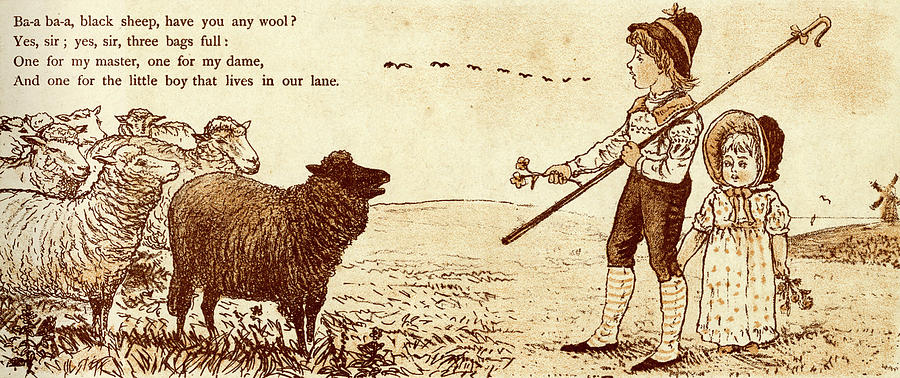
In 1774, a chapbook entitled “Tommy Thumb’s Pretty Song Book” was first published in London, England. This book is now ultra rare, with only two copies remaining intact, one of which is is held by the British library. This book was the second part of a set which is described by the British Library catalogue as being the first ever compilation book of nursery rhymes in print. It was in this book, that the rhyme “Bah Bah Black Sheep” was first recorded in its original form:

Bah, Bah, a black sheep,
Have you any Wool?
Yes merry, I Have,
Three Bags full,
One is for my Master,
One is for my Dame,
One is for the Little Boy
That lives down the lane

Baa Baa Black Sheep, Have You Any Wool? Drawing by Mary Evans Picture  Library


The final line, however, was changed by 1765 to "the little boy who cried in the lane" and has since then been changed back to the original. As you can see, there’s not a great difference between the original lyrics and today’s lyrics, but the question is begged, what is it about? Is there any significance to the black sheep, or the three bags for the specific people?
Firstly, it should be noted that this rhyme is probably one of the most contentious of the nursery rhymes, with several schools in America and Australia banning it or even changing the lyrics to “rainbow sheep”, or adding an extra verse “baa baa white sheep” The most likely reason for this controversy is that in the 1980s, several experts suggested that it might be linked to the slave trade. This theory however, has no evidence to back it up, and so cannot be confirmed. New Scientist Magazine even ran a small article in 1986 which attempted to squash this rumour, reminding readers that the plantation slaves to whom the rhyme was being attributed tended to farm cotton, not wool, and also that the rhyme was likely a lot older than its 1744 publication, due to how rhymes were often passed mouth to mouth for many many years before being committed to publication.

Another often given explanation for this rhyme is that of wool tax. In 1275, Edward I put a tax on wool, which raised its price by up to a third of its value. This then, led to grievances amongst the shepherds and the “black sheep” could be explained as an expensive deviation, since it’s wool could not be dyed, limiting it to black cloth only and thus decreasing its value. In 1930, Katherine Thomas, a scholar, published a book named “The real personages of mother goose”. Here, she considered how, centuries later than the wool tax, the already present discontent amongst the poor was in fact exacerbated by the low wages paid to farmers and shepherds in the time of Henry VIII, and that in Exeter there was a rising of several thousand people. She concluded that the Master and the Dame could refer to the king and queen, or simply nobility of the time, and refers to “the little boy who cried in the lane” being unable to afford his own wool. Sadly, the lyric she quotes, of the little boy crying in the lane, is not the original, as seen above, and likely was found in the 1765, “Mother Goose Melody” version of the rhyme. Therefore, it is likely that she was unaware of this earlier version.


Further investigation into the wool trade in the 1700s, closer to the time of publication of this rhyme, shows that there was another event which would have directly affected it during the reign of William and Mary in the late 1600s, that is, the restriction of the exportation of wool from England and Ireland. This led to conflict amongst clothiers and wool merchants within England and Ireland, due to the fact that the Irish merchants took little notice of legislation, and continued to trade, angering the Englishmen. This however, is mere speculation as there is no evidence that this could have become part of the origin of this nursery rhyme. In much the manner of the research which has been done previously, this too is merely a possibility. Without evidence, it is impossible to say which of these events, if any influenced the origin of this rhyme.

So, the conclusion of this article is one which shows only speculation. This rhyme was first recorded in 1744, but it’s true origins are unknown. The most likely speculation gives it to the unhappy farmers or shepherds of the wool trade, but in truth, nobody really knows where it came from!


Sources Used.

"Ariadene", New Scientist, 1986, p. 80
Baring-Gould, William Stuart, and Ceil Baring-Gould, The Annotated Mother Goose, 4th edn (London, 1962)
"BBC News | EDUCATION | Nursery Rhyme Ban Scrapped", News.Bbc.Co.Uk, 2017 <http://news.bbc.co.uk/1/hi/education/600470.stm> [accessed 28 March 2017]
Irish Wool and Woollens. III.” The Irish Monthly, vol. 10, no. 108, 1882, pp. 414–428., www.jstor.org/stable/20496779.
Opie, Iona Archibald, and Peter Opie, The Oxford Dictionary Of Nursery Rhymes, 1st edn (Oxford, England: Clarendon Press, 1951)
Thomas, Katherine Ewes, "The Real Personages Of Mother Goose", 1930 <https://archive.org/details/in.ernet.dli.2015.75797> [accessed 28 March 2017]

Welcome (intro)


Hello and welcome to my blog. Take a seat, pull off your boots and take a load off, just for a moment.


Firstly let me introduce myself. My name is Emma, I'm a writer from Plymouth with a background as both a  history researcher (PhD) and a psychologist (Ma). I've been writing for as long as I can remember, and indie publishing for about ten years.
This blog is intended for my readers to learn a little more about me, my methods and my research for various novels. You can also expect some of my research - a bit of history, a bit of local research and some random adventures too.
Finally, this blog will be where I do my updates on what I'm working on, and what is due out soon, and any personal signings I am doing! 

Below is a list of my work:

Ella’s Memoirs 

The First Haverleigh Novel: A stand-alone novel which birthed the creation of a whole lore universe. When Ella rescued the injured wolf in the forest, she had no idea of the events that act would set in motion. In the eyes of a creature, she saw the glimmer of humanity, she acted on it and was rewarded with a curse which would leave her ageless and lonely throughout the centuries. As she sits, lonely and forgotten, she begins to write her memoirs. A journey written by the hand of a woman who has survived the odds. From the witch-hunts of sixteenth century Germany, to the brothels of nineteenth century Paris. A tale of werewolves and vampires, of hopes dashed and of a love which refuses to die, even as the centuries pass. 


The Black Marshes 

The Second Haverleigh Novel: Frances Hodge was just a child when she met the man in the marshes, a man who gave her a gift which would stay with her and shift the whole course of her life. No longer entirely human, she stumbles into the world of the drinkers and the changers, into a life where fear and hatred is the only motivation for survival. As the seasons change and a new century falls, Fran’s group come head to head with a powerful enemy, an enemy which has already killed her husband and some of her closest friends. For Fran, the changers are primal, unfettered and viscous, but then she meets William Craven and everything begins to change. This book is an indirect sequel to Ella’s Memoirs but can be read as stand alone. 


Donor

The Third Haverleigh Novel: The world of the Drinkers survives on Donors. Some of them are willing, others are not! Bree Morgan is one of those who was not. Kidnapped and used as an unwilling blood donor, Bree barely has time to process the ordeal when she finds herself rescued by the hands of another of their kind. Once safely home, Bree faces a choice: return to normality, or follow her rescuer into the darkness. It's time to learn the difference between "good drinkers" and "bad drinkers", but when both have to hunt, drink, and sometimes even kill to survive, those lines become blurred. With her head turned one way, and her heart the other, Bree takes the only path she can… but the darkness isn’t done with her yet, and neither are the drinkers who took her in the first place….This book is an indirect sequel to Ella’s Memoirs but can be read as stand alone.


The Blood of the Poppies

Jessie was just eight years old when she found the dead body of a woman in the woods. The corpse which she stumbled upon, decayed and forgotten, fast becoming the key to a life she'd never have lived otherwise. Through this, she learns to love Ethan, the strange boy who moves to the village with his aunt and no other family, and apparently no history. But Ethan has a secret, one he will defend to the very end, and one which could get them both killed.


The King’s Idiot 

Book One of the Rostalis Darkfire Chronicles: In a world of peace and prosperity, a golden king sits on the throne of a land once ravaged by war. His illegitimate daughter, Niamh, a solitary and quiet girl, often jeeringly called “the king’s idiot” by her peers, begins to find where the cracks form in the gilt of the golden keep. A pressure is building below a façade of gentle rule, and the king’s new ideas on religion are driving the Woldermen – the wild savages of the marshes – back into the kingdom. Led by desperation as their temples are torn down, their sacred forests are felled and their priestesses murdered, the Woldermen are gathering their forces. When Niamh is taken hostage by a group of Wolder, led by a familiar face from her past, she is faced with a choice. If she takes one path, it could lead to the destruction of her kingdom, but if she takes the other, a whole new world awaits her. Torn between two worlds, the princess must make her choice quickly. On one side is her father, a man beloved by his people and who raised a bastard child as though she were his true daughter, but on the other is the man she loves, a man with a cause, with a motive to bring it all down around them. Whichever path Niamh chooses, conflict is imminent and the golden reign is at risk.


The Queen's Dragon

Book Two of the Rostalis Darkfire Chronicles First there was treachery, and then there was war. For the inhabitants of Rostalis, surely a return to peace was due? As Queen, Niamh was faced with a whole new set of challenges now that the war was won. The rebuilding of the mage council, the purging of her father’s influences on the land and, most of all, the mending of the conflicts caused by her ascension to the throne. But peace is hard come by and once the door is open for war, it’s hard to push it closed again. Niamh will have to give everything she has if she is to survive and hold the throne, and this time - with her husband missing and her Wolder Army disbanded - she’ll have to do it alone.This epic fantasy is the follow on from The King's Idiot, and is set twelve years into the future. Niamh needs to stop this new war before it destroys everything, put the council back together with only child-mages left alive, and on top of it all, she needs to discover if her husband is alive or dead!


The Man Who Painted a Fairy

A gothic romance with a twist!
When Anna is orphaned in a terrible house fire, she finds herself thrust friendless and penniless into the world. From pampered child to dowdy governess, Anna has to fend for herself taking work where she can find it. Through this, she meets and falls in love with the strange and solitary painter, Nathaniel, who resides at the neighbouring Kellisham Hall. But who is Nathaniel? Who is he hiding from and why does he live such a solitary life, locked away in the dark behind firmly closed curtains? As circumstance once more pushes Anna out into the world, darker forces are at play and they won't stop at anything to get to Nathaniel...
...even if that means preying on the ones he loves.