Gothic Romance - A Dead Genre?

* NOTE - this was originally written for Women's day 2020. 


With today being international women's day, I thought I'd write a little amble on the genre where I started writing (and reading). Gothic Romance. Perhaps the "anti women's day" genre in form of content, but a genre which is riddled with female influence, both in character base and in female authors. 

Background: I was a young reader, and so when I was about 12 I was done with children's books, no longer finding them a challenge. Coming from a fairly impoverished background, my mother, rather than buy me new books, just gave me access to the more "child-friendly" of her own bookshelf! Perhaps it was this, at such an impressionable age, which modelled the way my youthful brain worked, and instilled in me a sense of utter romance, as well as a love of the darker side of history, gothic, and Victoriana. You see, my mother was completely and utterly obsessed with a writer named Victoria Holt, and due to the lack of anything above PG in content, it was these I was given permission to read, initially. 

Writing: I think it is honest to say that there are elements of gothic romance in most of my novels. Even my supernatural novels contain the staples of the genre, especially in the parts which cover historical content. However, I have also written 5 pure gothic romance novels too. These are as yet unpublished, however I am hoping to bring you the first, "The Lunatic of Thornham Heights" or "The House Above the Waves", very soon. These books are 100% an indulgence for me as a writer, however, in a modern era, a modern touch was needed in the creation of such stories. I love the tropes, the atmosphere, the "feeling of such books", however, with this being a genre which was born in a very different era to the one we live in, a modernisation was also needed.

Gothic romance as a genre - the history: Ok, so gothic romance is a genre almost as old as pure gothic, if not older in some ways. By pure gothic, I mean famous stories such as Dracula, Jekyll and Hyde, Frankenstein and so on. Gothic Romance is a similar genre but with some distinct differences. It is a genre which relies on romance and intrigue to further the story however, there are often elements of the supernatural, or at least hints towards it (sometimes in a scooby-doo-esque style - "no it wasn't a ghost, it was the mad old woman in the attic the whole time!"). Gothic Romance is a female driven genre, often written in a female voice. Examples of it often incorporate a lonely and mysterious feel, using scenery such as eerie old mansions, isolated moors, sometimes with a heroine being sent to another country where everything is strange and alien to them. Some people also consider work such as that of the Bronte sisters to be in this genre, especially Jane Eyre, which holds all the tropes of gothic romance.  This genre is often considered to have been founded in 1764 with a novel called the Castle of Otranto.

The genre laid low for some time in the latter part of the Victorian era, never quite finding its feet, however it was revived by writers such as Daphne Du Maurier in the 1940s, with her most famous work, Rebecca, falling very neatly into the genre. This is no coincidence as it is well-known that Du Maurier was heavily influenced by the Bronte sisters. By the 1950s, the genre was on the rise again. Here
we had female writers such as Victoria Holt, Constance Haven, and Mary Stewart creating a 1950s lens on the genre. This created a very unique view - 1950s women writing stories of  1800s women! Perhaps in some ways, both groups the underlings of what feminists would term the patriarchy. This is apparent in the writing - glaringly so! The traditional gothic romance sets up a tragic heroine who needs to be rescued. She should be "plucky and headstrong", but ultimately require saving by a "strong man". Perhaps this is why this genre is now so under represented by modern writers? People shy away from such outdated stereotypes, and yet I quite enjoy playing with the genre and stretching it's boundaries. 

One of the things I like to do most is to take the "strong male lead" off of his pedestal. The untouchable "perfect man" in such stories is often as unrealistic as the submitting doe of the female lead. Giving them back their humanity is something I've striven for over and over. To do this, I've used tools such as mental illness, (the Lunatic of Thornham Heights), and poverty (So long my Sorrow) for example. Swap the stereotypes, turn them upside down. A rich woman with a penniless lover, a man who suffers depression and anxiety, male spiritualists, female sceptics. I've also added homosexuality and bisexuality to my novels - not just because I want to raise awareness that it was historically present, but also to push the boundaries of a genre which never previously accepted it. I have also written about race , adding people of colour to the very whitewashed and often racist genre. (The House Above the Waves has a strong message against racism, whilst exploring it in the context of its era.) Again, though, I'm getting off topic! My point is that just because a genre is outdated, does not mean it cannot be modernised, whilst still maintaining the tropes at its core! 

Let me know what you think in the comments :) 

Nursery Rhyme Origins - Little Miss Muffet


Little Miss Muffet,

Sat on a Tuffet,

Eating her curds and whey.

Along came a spider,

Which sat down beside her,

And frightened Miss Muffet away


This little rhyme is one of the most well-known nursery rhymes and is still recited by children from all over. There are two popular theories  that I can find from a brief search on google, as to its origin and meaning, with one camp attributing it to a Dr Thomas Muffet (who died in 1604), as an ode to his stepdaughter, and others claiming it is a metaphorical reference to Mary, Queen of scots. I thought I would investigate these two theories for you today :)
First and foremost, an examination of the rhyme in printed literature:

The earliest recorded version of this rhyme would appear to be an 1805 book entitled “Songs for the nursery”. An 1808 reprint of this is available online at archive.org (see references below). An early tome which is considered the original book of nursery rhymes, “Tommy Thumb’s pretty song book”, printed in 1744, does not hold any reference to this rhyme. The verse seems to have come to popularity in the mid-nineteenth century amongst those recording nursery rhymes, and especially after 1878 it was reprinted multitudes of times. Despite that the rhyme was often printed with slight variances (a “black spider” etc) it was pretty much the same verse. In his 1849 tome on nursery rhymes, James Halliwell Phillips neglected to add Miss Muffet, but included it as “Little Mary Ester, Sat upon a tester, Eating of curds and whey.”  This is interesting in the fact that Halliwell-Phillips was an avid collector of nursery rhymes and therefore could tell us that before 1850, the “Miss Muffet” version was perhaps a lesser known variant. The Mary Ester version is claimed (by Opie and Opie, who were experts on the subject of nursery rhymes) to originate in 1812 in printed material, however I have been unable to locate a copy to confirm this.

 In 1878, William Adolphus Wheeler reprinted the rhyme with the Miss Muffet opening line, alongside two very closely similar verses, the most notably similar being:

Miss Poll Parrot, 

Sat in her garrett

Eating some toast and tea

A little brown mouse

Came into her house

And stole it all clean away.


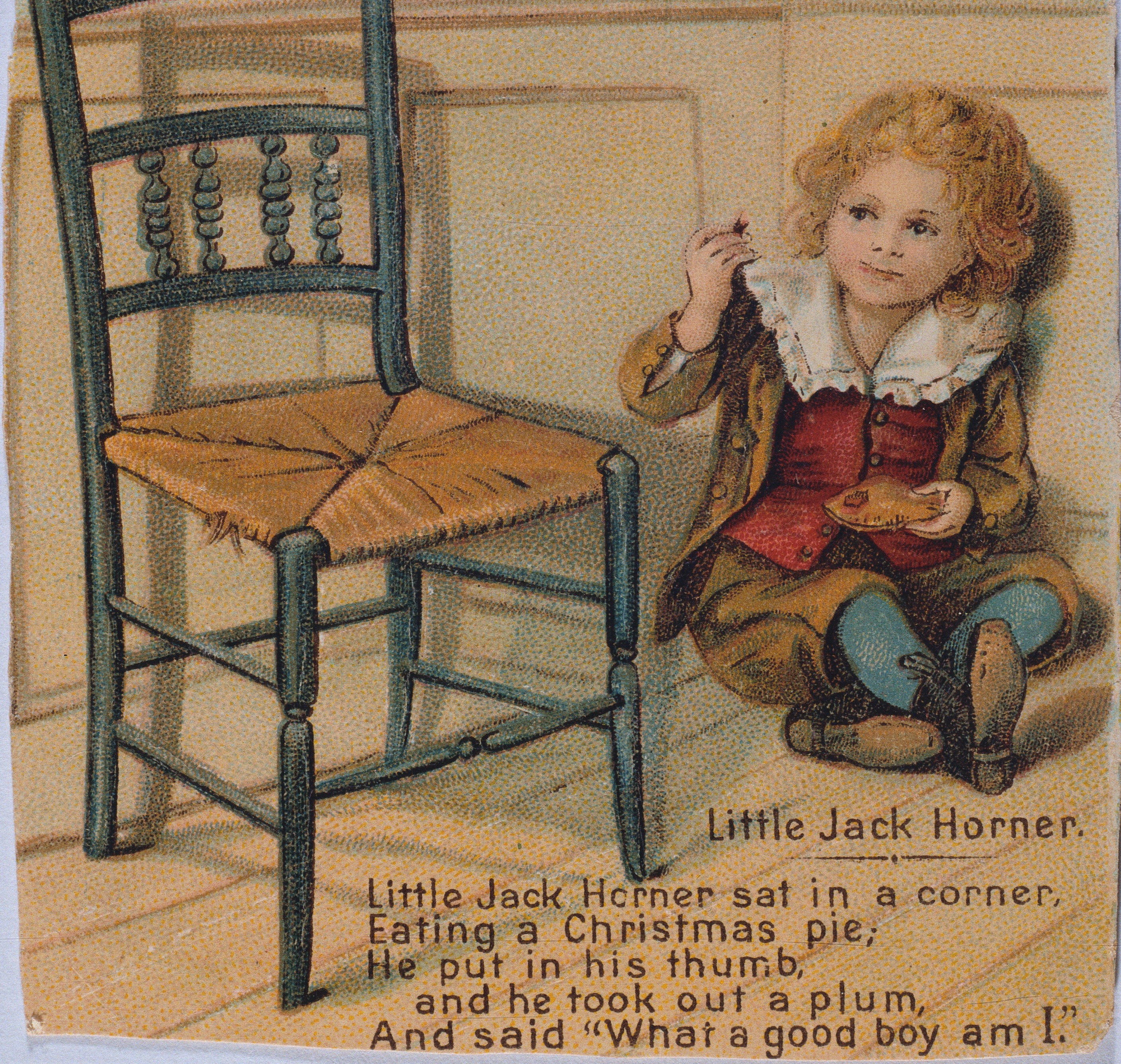
Opie and Opie  discuss in their 1955 dictionary of nursery rhymes, how similar some of the form of the rhyme is to “Little Jack Horner” which was a popular rhyme first found in chapbooks in the early eighteenth century (1720).

Nursery Rhymes Are Not What They Seem: The Story Behind “Little Jack Horner”  | History Daily

Opie and Opie also list a multitude of other potential originals, discussing the idea of somebody sitting and pursuing an action (mainly eating something) which is then interrupted by somebody or something arriving or another important action.


So, firstly, let us examine the wording used in the rhyme.
Nowadays, the word Tuffet is used to describe a footstool fairly commonly, however this has not always been the case. In fact, it might even be that the use of the word tuffet has come from people’s interpretations of this rhyme, and especially the illustrations of it which show the lady on a foot-stool. Prior to the nineteenth century, a tuffet was more likely describing a grassy knoll, therefore indicating that Miss Muffet had taken her food outside.  

And what of that food? Curds and Whey, pretty much, are like a sweet cottage cheese. They are a by-product of cheese-making and have been around for centuries (as long as cheese-making), and so this gives no clue as to the date of the rhyme.The name little Miss Muffet might give a clue though. One of the most popular theories about the origins of this rhyme allude to a Dr Thomas Muffet who was an expert on insects in the 1500s. in 1885, he was listed in the dictionary of national biography to have been especially interested in spiders. Whilst this this rather a coincidence, and fun to imagine how perhaps he wrote the rhyme to tease one of his step-daughters, there is literally no evidence whatsoever to link the rhyme to this man, other than the coincidence of his name and profession. He is not known for writing poetry or rhyme, and there is no evidence that he wrote this one especially considering that the rhyme only appears in 1805.  

Another version of this theory, (as quoted by the North Mymms History Project Website) pertains to the poem being written about Dr Muffet, rather than by him, and discusses the use of spiders in 16th century medicine and how he frightened his daughters by keeping spiders in the house or even dumping spiders on them.Now, I have not researched extensively into the use of spiders in medicine, but aside from the use of spider’s webs in bandage making, I can find no evidence to support spiders being used medicinally by Dr Muffet, however, I suppose it is plausable. In fact, and I did not spend a great deal of time on this, I struggled to find any academic references at all to sixteenth century doctors using spiders as medicine. (If you know of any do feel free to educate me by posting in the comments!) What I did find, however, was nineteenth century writing on medicine which alluded to swallowing and touching spiders in order to cure, amongst other things, spider phobia! (Frank Cowan’s 1865 book, curious facts in the history of insects for example). 
During the nineteenth century, especially later in the nineteenth century, there was a surge in the emergence of interest in science, including natural sciences, and so it is highly possible that doctors such as Dr Muffet were once again taking the attention of science scholars. An example of this is in a journal (a monthly or sometimes quarterly academic magazine-like book) from 1886, where Dr Muffet was the subject of a whole article. So perhaps if there is a link here at all, it is perhaps feasible that this well-known spider enthusiast loaned his name to the late eighteenth/early nineteenth person who penned the rhyme – but this is pure speculation at this point.

Another popular theory, many, many websites and blogs tell me, is that the rhyme is a metaphor for Mary, Queen of Scots. However, I have actually struggled to find anything of note about this theory other than that Miss Muffet was Mary, Queen of Scots, and that the “spider” was John Knox who was a religious reformer. Therefore, this seems almost to be an internet myth in itself, with very little to no actual evidence to it. Nowhere in literature have I found John knox referred to or even characaturised as a spider, and there is no link with the muffet name to Mary.

Conclusion.I’m afraid the answer to this one, like with so many nursery rhymes, is that we just don’t know. The facts of the matter are that the rhyme in it’s popular format was first published in 1805, but was based on an older style rhyme, and that in the 1500s there was a doctor who was obsessed with spiders by the name of Muffett.
My personal feeling on this one, is that the rhyme itself, in structure and style, is just another version of a much-used formula which originated many years prior to 1805, albeit with different words, and that the Miss Muffett reference was an 18th century memory of a doctor who was obsessed with spiders, but in the end, that’s majoratively speculation.

References

Cahan, David, From Natural Philosophy To The Sciences (Chicago: The University of Chicago Press, 2003)

Collingbourne, Huw, "Tuffets And How To Sit On Them", Sircourtlynice.Blogspot.Com, 2010 <http://sircourtlynice.blogspot.com/2010/09/tuffets-and-how-to-sit-on-them.html?m=1> [Accessed 4 July 2019]

Cowan, Frank, Curious Facts In The History Of Insects; Including Spiders And Scorpions. A Complete Collection Of The Legends, Superstitions, Beliefs, And Ominous Signs Connected With Insects; Together With Their Uses In Medicine, Art, And As Food; And A S By Frank Cowa (Philadelphia: Lippincott, 1865), p. 395

Hardwicke, Robert, "Hardwicke's Science-Gossip", Nature, 22 (1886), 158

Opie, Iona, and Peter Opie, A Nursery Companion, 2nd edn (Oxford: Oxford University Press, 1997, originally printed 1951), p. 382

Tabart and Co, Songs For The Nursery, 2nd edn (London: Bond Street, 1808), p. 23

"Tommy Thumb's Pretty Song Book", The British Library Collection Items, 2019 <https://www.bl.uk/collection-items/tommy-thumbs-pretty-song-book> [Accessed 4 July 2019]

Wheeler, William Adolphus, Mother Goose's Melodies (Cambridge: Hurd and Houghton, 1878), p. 72

Termination of Pregnancy in Eighteenth Century England

 **Please be aware that this post pertains to termination of pregnancy. If this is a topic which causes distress or triggers mental health conditions, please read no further.**

In researching for a novel which I am currently writing, I came to the realisation that whilst I already knew a great deal about the topic of pregnancy termination in the nineteenth and twentieth centuries, I actually knew little about the practice in the eighteenth century (1700 - 1800). In this particular novel, the main character becomes aware that one of her friends is thinking of terminating a pregnancy, and so I decided to look a little further into what that would have entailed.

Firstly to this essay comes the legality of it. Most people who are familiar with Victorian history or even twentieth century history or television programs which depict abortions will expect that such a practice was always illegal in England prior to the 1967 ruling which allowed it to be legal in certain circumstances.[1] However, in fact abortion was not made completely illegal in England until 1803.[2] Before then, abortion until the quickening (when the baby moves) was not considered illegal, and even abortion after this was not severely punished as it would be later on. The quickening was considered by the church to be when the soul entered the fetus, hence the distinction between the two.[3] The legal situation remained like this for centuries. Despite that in the time this novel was set, which I have given the vague time-frame of the late eighteenth century (1750 – 1800ish), it was therefore still completely legal to terminate a pregnancy before the quickening. It was however, still frowned upon. In a book on medicine from the mid-1700s, this statement appears:“Any mother who procures an abortion does it at the hazard of her life yet there are not a few who run this risk merely to prevent the trouble of bearing and bringing up children. It is surely a most unnatural crime, and cannot, even in the most abandoned, be viewed without horror and in the decent patron, it is still more unpardonable.”[4]

 After 1803, however all forms of pregnancy termination were illegal and the punishments were harsh. Before the quickening, abortion was punishable with a fine or imprisonment, or even transportation for up to 14 years. After quickening, abortion was punishable by death.[5]

 Whilst it might be assumed that the early methods of abortion were quite different, to the quack methods of the nineteenth and early twentieth century back-street abortionists, there is a massive amount of cloud still over how these procedures were actually done. In her essay on eighteenth century abortion, Kate Lister explains that in fact unless the woman died, there are no medical records at all of what was done.[6] However, from as early as the middle ages, there is mention of the use of herbal concoctions for the purpose.[7] “Powders” are also cited in the early American sources, which were also likely powdered herbal or chemical concoctions.[8] Tim Hitchcock in his book on eighteenth century sexuality, describes several advertisements for tonics and herbal remedies which were printed readily to the public. Some claimed openly that they were to "restore menstrual flow", whilst others were more discreet, giving a list of symptoms and the disclaimers that pregnant woman should beware that the concussions would “certainly bring on a miscarriage.”[9]

The truly horrific images, then, of surgical abortion being performed by “back street” doctors looks to be a rarer concept in the eighteenth century than it was to become in the centuries following. This is likely due the the legality issues. That is not to say it did not happen though. The use of steam and the insertion of water into the uterus were certainly applicable to the eighteenth century England as abortion methods. The use of surgical instruments too, is much older than the eighteenth century, with mentions as early as the tenth century of their use in Persia[10] and even to Greek and Roman times.[11]

Therefore, abortion, whilst considered immoral by the church in the eighteenth century, was not illegal. The practice of eighteenth century abortionists is still very clouded in regards to methods, and whether surgical types of interventions were used. It is likely that the main ways of achieving a miscarriage were powders and medicines which were consumed. The understanding of surgical methods however, did exist and it is highly possible that these treatments which were barbaric and dangerous through lack of regulation, were indeed used during this time, locked away behind closed doors.


[1] William Buchenan, ‘Domestic Medicine’ (London: Stradel and Cadell, 1769)

[2]  Kate Lister, ‘Bringing down the Flowers’: Abortion in Eighteenth-Century Britain,’ (Unpublished Essay/Thesis, 2007)

[3] https://abortionrights.org.uk/history-of-abortion-law-in-the-uk

[4] William Buchenan, ‘Domestic Medicine’ (London: Stradel and Cadell, 1769)

[5] R Sauer, ‘Infanticide and abortion in nineteenth-century Britain’, (Population Studies Journal, 32:1, pp. 81-93)

[6] Kate Lister, ‘Bringing down the Flowers’: Abortion in Eighteenth-Century Britain,’ (Unpublished Essay/Thesis, 2007)

[7] John M Riddle ‘Eva’s herbs: A History of Contraception and Abortion in the West’ (London: Harvard University Press, 1997)

[8] Cornelia Dayton, ‘Taking the Trade: Abortion and Gender Relations in an Eighteenth-Century New England Village’ (The William and Mary Quarterly Vol. 48, No. 1 (Jan, 1991), pp. 19-49

[9] Tim Hitchcock, ‘English Sexualities, 1700–1800’ (London: Macmillian Education, 1997)

[10] Carol Joffe, ‘Abortion and medicine: A sociopolitical history’ (Unknown book chapter, 2009)

[11] J.M Riddle ‘Contraception and Abortion from the Ancient World to the Renaissance’ (London, Harvard University Press, 1994)

Amelia Dyer - the Baby Farmer

   In the year of 1869, a woman named Amelia Thomas (sometimes referred to as “Ann” or “Anne”) was widowed in London, England. Left unable to support herself, Amelia took to what is referred to in a modern tongue as “baby farming”.[1] Amelia was a serial killer and was found guilty in the late 1890s of multiple counts of infanticide. She was a figure I have encountered in both my History Ma, and my PhD work, however as she lived in a time after the era designated by my PhD I thought I would spend a few moments detailing her life here.

Image result for amelia dyer

In Victorian London, not only was pregnancy out of wedlock a disgrace to those who found themselves in that situation, but it could completely ruin a young woman’s prospects of a normal life. Due to this, there were many boarding houses and private homes where a young woman could go to have her child privately to then put it up for adoption. Single mothers were not just harshly judged, but in other cases poverty stricken too and this condemned many of them to desperation due to an inability to adequately care for and feed more children.[2] An unmarried mother’s only alternative was either to abandon her child or foster it out into the care of another person. Many women, therefore, adopted this practice out of love and hope for a better future for their child. Sometimes these adoptions would be forever, and others were to last only until the mother was able to take the child back in a fashion similar to what is now called fostering.However, in every avenue of life where there is desperate need, there is room for corruption. Due to the sheer disgrace of such pregnancies, and the desperation of the “young woman in trouble”, there arose a group of people who began advertise for children to adopt, or in some cases, to answer the advertisements for adoption. They would agree to take on the babies under the guise of offering a loving home, as long as the mother was able to pay a sizable one-off fee, or continue a series of payments for the duration of the child’s life.[3] One of the most famous examples of this in literature were the Thenardier family in Victor Hugo’s Les Miserable, who took on the young heroine Cosette for the fee of ten francs a month.[4] Like poor Cosette, often children adopted in such a fashion were taken in for financial gain alone, and therefore were often neglected or mistreated. These people, often women, became known as baby farmers.[5]


Amelia Dyer was one such person. Amelia chose to advertise in local newspapers for children to adopt. She used a fake name, and assured the mothers that the child would go to a good safe home. In 1872 she remarried, taking the name would was to become so infamous, Amelia Dyer.From the early days of her career as a baby farmer, Amelia had no mind to keep the children alive. At first, she did not directly cause harm to the babies, but allowed them to die through neglect, acquiring death certificates from local doctors for seemingly legitimate causes. However a one of the doctors became suspicious and Amelia was arrested for neglect and served 6 months hard labour.It was around the time of her release that Amelia’s sanity crumbled. She spent time in and out of various asylums, including the Somerset County Asylum and attempted suicide twice. She did not, however, give up the baby farming and it was here that she began to take matters into her own hands, taping the necks of the babies who were intrusted into her care to end their lives, and then dumping the tiny bodies into the Thames.


It is not known how many children Amelia Dyer murdered. Eight bodies in total were found in the Thames, plus the multitudes which were killed by her neglectful care. The actual figures are supposed to be much higher. Dyer only pleaded guilty to one murder, that of a barmaid’s daughter Doris, daughter of Evelyn Marmon who gave evidence at her trial.[6]

Amelia Dyer was executed in 1896, after over twenty years of murder.[8] She is thought to be one of the most prolific serial killers who have ever lived in England, especially those of child murder. 
During trial, the case became so well-known, that even folk songs about her appeared in popular literature. The following, for example:
The old baby farmer, the wretched Miss DyerAt the Old Bailey her wages is paid.In times long ago, we'd 'a' made a big fy-er
And roasted so nicely that wicked old jade[7]
Her case is also the subject of a song by steampunk/Victorian punk band, The Men Who Will Not Be Blamed For Nothing. The song is called Baby Farmer from their fourth album.


[1] Charlotte Beyer, “Baby Farming: Representing Amelia Dyer.” The Human, 5:1.[2] Allison Rattle and Alison Vale. The Woman Who Murdered Babies for Money: The Story of Amelia Dyer. (London: André Deutsch, 2011), p.13.[3] Annie Cossins, The Baby Farmers. (Sydney: Allen & Unwin, 2013)[4] “Sparknotes: Les Misérables: Cosette”, Sparknotes.Com, 2020 <https://www.sparknotes.com/lit/lesmis/character/cosette/> [Accessed 20 February 2020].[5]Cossins, Annie. The Baby Farmers.[6] Online: The Old Bailey Online, Amelia Elizabeth Dyer REF: t18960518-451 [https://www.oldbaileyonline.org/ accessed 20/02/20][7] Lionel Rose, The Massacre of the Innocents, (London, Routledge, 1986) p.160[8] “Amelia Dyer” The Scotsman, Thursday 11 June 1896 p.5

Nursery Rhyme Origins - The Grand Old Duke

 So, I'd imagine many of us have sung this as a child, perhaps making the actions of marching up and down hills along with it as is dictated in many a playground... but who was the Grand Old Duke of York, and why did he do all this marching?


Firstly, in case you don't know it, here's the rhyme.

Oh, The grand old Duke of York,
He had ten thousand men;
He marched them up to the top of the hill,
And he marched them down again.

And when they were up, they were up,
And when they were down, they were down,
And when they were only half-way up,
They were neither up nor down.

In looking into the origins of this rhyme, I was expecting to stumble over a theory or two about who this Duke of York might be, and in truth that much is true - there are quite a few! However, what I also found was a list of variations which seem to be older than the Duke of York version, the oldest of which (according once again to our friend James Halliwell-Phillips) actually spoke of "The King of France with forty thousand men," who "came upon a hill and so came downe againe"This is quoted in the satire "Pigges Coranto, or Newes from the north" which was written in 1640. The song which includes it is labelled "Old Tarlton's Song.Tarlton, from what I can discover, was a "Clown" or comedic writer from the mid-fifteen hundreds although Halliwell-Phillips claims that he didn't actually write some of the tracts he is known for. He was, however, very well esteemed and considered a great wit!

Another version of this rhyme is that which includes the Dutch commander Maurice of Orange. It loosely translates to :

The hero prince Maurice 
came with a hundred thousand men 
with them he went up the hill and also down again


This version, however, is most likely to be a direct copy of the English version, and likely originated in it's English form. So, bearing in mind that originally this rhyme was not about a "Grand old Duke", let's ponder who might be being referred to in the modern version of the rhyme. Firstly, we have no clues about the date it was recorded, with the first complete version being found in 1913's Mother Goose (by Arthur Racken). Opie and Opie, however state that there is a version which references a Duke of York recorded in 1890 but is not the complete version we know now.

From here on in, the answer seems to come down to speculation. Could it be an early reference to Richard, Duke of York (1411–1460) who died during the war of the roses atop the Bailey of a Motte and Bailey castle with 8000 men? This theory seems unlikely due to the fact that this song was likely not written for another hundred or so years, and the details of the early versions don't match up.

More likely, this rhyme speaks of a battle during the French revolutionary wars. After the French Revolution, war broke out all over Europe with France, under it's revolutionary government. This conflict is perhaps too much to go into here, but suffice to say that during this skirmish, England launched what was to be known as the Flanders campaign. Flanders, in northern France, is well-known for being a very flat country, but with the exception of Cassel, a small town built up on a Hill. The leader of this campaign was Prince Frederick (d. 1827) who was Duke of York at the time, and whose campaign ended in defeat and the humiliation of being recalled to England. In this case then, the term "grand old Duke" could have been satirical or sarcastically spoken, rather than respectfully and with reverence. As stated above, however, this is mere speculation, and this modern version of the rhyme could in fact be one of many Dukes of York.


Sources:

Opie, Iona Archibald, and Peter Opie, The Oxford Dictionary Of Nursery Rhymes, 1st edn (Oxford: Oxford University Press, 1997)
PIGGE, Pigges Corantoe, Or Newes From The North. [A Political Satire.], 1st edn (London, 1642)
"Pigges Corantoe, Or, Nevves From The North. - LUNA: Folger Digital Image Collection", Luna.Folger.Edu, 2017 <http://luna.folger.edu/luna/servlet/detail/FOLGERCM1~6~6~163446~109948:Pigges-corantoe,-or,-Nevves-from-th> [accessed 27 April 2017]
"Tarlton's Jests, And News Out Of Purgatory: : Halliwell-Phillipps, J. O. (James Orchard), 1820-1889, Ed : Free Download & Streaming : Internet Archive", Internet Archive, 2017

Victorian Spiritualism

 Victorian spiritualism was a movement built on the notion that the dead could be communicated with via the work of mediums. The movement was unusual for its time, in that it was led by women, its meetings were majoritively attended by women, and in many cases women conducted these meetings alone, out from under the watchful eye of their male counterparts.


I do feel I need to define that this article is specifically about the rise of the spiritualist mediums movement, and is not about a modern tongue terms "spiritualism" in general. Those are very different things, as ever - language evolves and takes us with it! This article also does not debate or deny the existence of mediumship, spiritualists or the feats they were able to perform. That is a very well-done and tired debate that I do not have the space or inclination to get into :) Instead, this article is a quick overview of the beginnings of Victorian Spiritualism and its links to early feminism.

Origins: The spiritualist movement first began in America in the late 1840s with the fame of two sisters who claimed to be able to communicate with a spirit which rapped on tables to answer questions. These women, known as the Fox sisters, became the first famous mediums in America, after they claimed to be able to communicate with a dead murder victim. In 1852, another American medium, Maria Hayden, came to England and introduced Spiritualism to an English audience, where it soon became immensely popular.[1] During the 1850s and the following decades, there was a boom seen in the Spiritualist movement in England, from a few mediums trickling over from America in the early 1850s, to a massive amount of people practising many of its activities, such as table rapping and full-blown seances, in households and halls all over the country by the end of the century. This led too to the rise in scientific exploration of the supernatural, with the Cambridge ghost club being founded in 1851, this becoming the London Ghost club in 1882 which was the same year that the Society for Psychical Research (SPR) was founded by many of the same people.[2]

Background: For the average Victorian woman, life was often somewhat restricted by the social norms of the patriarchal society about her. This was especially true in the middle and upper classes. It was unusual for a woman to have any real power in her own life, or a voice outside of the home. [3]. A Victorian woman was expected to behave, to be polite and mild of temper, and to attend to the wishes of the men around her. Very few Victorian women owned property or businesses, nor did they run groups and societies other than charity work. (although some did - a side note, in my PhD research, I have come across several female asylum owners!) How much this stereotype was actually adhered to is debatable, but there is no doubt that the middle to upper class Victorian woman was one without very much agency in her own life.

Spiritualism in England: Spiritualism then, being brought over from America by female mediums, with tales such as those of the Fox sisters gave an opportunity for English woman to stand outside of her normal restrictive boundaries to step into a role which gave her a level of authority unusual for the time[4]. The rise of the spiritualist movement led to hundreds of ladies taking up mediumship all

over England, and thousands flocking to witness them. This was both a public spectacle, and a private one, with many people practising privately at home[5]. Georgina Byrne states in her research into the cultural implications of spiritualism, that outside of personal accounts and letters it is difficult to really examine private seances and spiritualist endeavours as these are generally not so well discussed or reported in media such as newspapers.[6] What is apparent though, is that there were many such seances and Janet Oppenheim discusses how it was more likely to be these private “Drawing room seances” which allowed the movement to really take hold in England.[7]
The rise of the sciences too played their part in the popularity of spiritualism and here it is possible to examine how the gender roles might have been affected, as in general for the era, the sciences were seen very much as a man’s domain. Spiritualism fit well into the new scientific way of thinking, as it gave the hint of an afterlife which was perhaps more scientifically testable than that of religion.[8] It might be for these reasons, then, that despite that spiritualism allowed women to indulge in what were considered normally unacceptable feminine behaviours, the female mediums were given more freedom because what they were doing was interesting to the men studying the newly blooming fields of sciences. For the female mediums, there was also the opportunity to discuss such matters as science and religion, doing so through the guise of speaking for the spirits.[9] Again, this allows for the women to have more authority, in being able to discuss matters where normally they would not be expected to.

Male Mediums: The spiritualist publication entitled The Two Worlds printed in most editions a list of

“Mediums and Speakers” from across England. This list was maintained by self-referral and gave the name and address of contact. The magazine does stress that the list accuracy was maintained by the mediums themselves so there might be omissions, but still it gives an interesting insight into the prevalence of mediums willing to offer their services. In July 1887, 19 of the listed 101 mediums were unmarried women (as identified by the prefix “Miss”), 31 were married women working alone, 5 were both “Mr and Mrs” at the same premises and 46 were male. [10] This then shows that a great deal of women were taking part in mediumship, but also that a good proportion of the self-reported mediums were male. A year later in 1888, the figures were similar but with a rise in the proportion of males, with 18 unmarried ladies, 34 married ladies 4 couples and 56 men registered. What is also seen though, is that whereas female mediums operated at home, within their groups, the male mediums took the idea and altered it, making societies for scientific study and so on.  In 1851, a group from Cambridge formed to investigate the supernatural. In their circular, they discuss how they hoped to “Earnestly investigate” the nature of supernatural phenomena, and offer a classification table with articles such as “Appearance of Angels” and “Spectral Appearances” of various kinds.[11] This group was known as the Cambridge Ghost Club, and founders were all male, indeed it was not until 1927 that women were permitted to join.[12] This trend seems to appear throughout the 1860s and 1870s, an article in the spiritualist in 1871 states:
“The necessity of forming a psychological society to investigate spiritualphenomena, for the purpose of bringing the manifestations now socommon into the realm of law and order. As will be seen by thecorrespondence on another page, several highly intelligent gentlemendesire that such a society should be formed.”.[13]

Again, this shows the gender stereotype of the time, with the "gentlemen" being the ones to desire this scientific research. It can also be seen from examining the lists of members from smaller clubs, that these types of gatherings and clubs tended to be male-led. However, this was changing. In 1874, for example, in the July issue of The Spiritualist, there is a small advertisement for the Liverpool Psychological Society, who although not a spiritualist society do advertise as being in pursuit of the truth through means of psychology, and development of both mental and spiritual powers. The listed office bearer shows that several of the office bearers for 1874 were female. [14]

In conclusion then, it would appear that the spiritualist rise in England during the 1850s was fuelled by the women of the movement. They seemed to spread the word via peer groups and circles of acquaintances. The women who advertised themselves as mediums were predominantly married women, although the male population in the movement seemed to be growing. Despite a large amount of evidence which examines the public face of mediumship, there were also a large number of women practising the art at home, for reasons of self-enrichment, or even just for the fun of it. The fact that the women were the main instigators of the movement does challenge the gender roles of the time, as they were able to act in ways previously denied to them. This was due to the safety of the spiritual influence over them, which set them apart from the restrictions of normal society.

[1] Candice Gregory, "A Willing Suspension of Disbelief", Loloya University, 1989 <http://people.loyno.edu/~history/journal/1989-0/gregory.htm> [Accessed 19 April 2018].
[2] Georgina A Byrne, Modern Spiritualism and The Church of England, 1850-1939 (Woodbridge: Boydell, 2010), pp. 54
[3] Marlene Tromp, ‘Spirited Sexuality: Sex, Marriage and Victorian Spiritualism’, Victorian Literature and Culture (2003), pp. 67
4] Alex Owen, The Darkened Room (London: University of Chicago Press, 1989), pp. 199-205
[5] Georgina A Byrne, Modern Spiritualism and The Church of England, 1850-1939 (Woodbridge: Boydell, 2010), pp. 50-52
[6] Georgina A Byrne, pp. 52
[7] Janet Oppenheim, The Other World, 2nd edn (Cambridge: Cambridge University Press, 1988), pp. 8-12.
[8] William H. Swatos, "Spiritualism as A Religion Of Science", Social Compass, 37.4 (1990), 471-482. pp. 475
[9] Marlene Tromp, ‘Spirited Sexuality: Sex, Marriage and Victorian Spiritualism’, Victorian Literature and Culture (2003), pp. 67-81
[10] Robert Dale Owen, Footfalls on The Boundary of Another World (Philadelphia: J.B. Lippincott & Co., 1860), pp. 513-515.
[11] The Two Worlds, "Mediums and Speakers", 1887, p. 110.
12] Peter Underwood, The Ghost Club: A History, 1st edn (London: Limbury Press, 2010), p. 12.
[13] The Spiritualist, "A Psychological Society", 1871, pp. 1-2.
[14] The Spiritualist, "The Liverpool Psychological Society", 1874, p. 1.

Nursery Rhyme Origins - Jack be nimble

 Jack be nimble

Jack be quick

Jack jump over

The candlestick.


First found in a rhyme collection in 1815, this rhyme is not apparently as ancient as some nursery rhymes, especially since it would appear that it doesn’t pre-date this time.This rhyme, it would seem, is much more literal than some of the others we’ve looked at so far as it alludes, quite simply, to the tradition of candle leaping. Most notably, in England there is a feast to Saint Catherine (25th November) which is sometimes known as Catterns day. St Catherine is the patron saint of spinsters, and was celebrated by lace-makers, spinners and rope-makers throughout the 1800s. At the culmination of these celebrations, a lighted candle would be jumped for luck. If it remained alight, then St Catherine was said to have granted such luck, and the following year would be prosperous. Sadly, despite the great value of lace, the lace-makers did not often have a great deal of money and since candles were expensive, often they would work with just one candle burning. Perhaps this is how Candle jumping became a part of the Catherine’s day celebrations.

Another reference to this custom is in social/local historian Ginette Dunne’s “fellowship of song”. This book is a study of singing traditions which was published in 1980 and contained what is now known as “Oral History”, that is an examination of stories told first hand to the researcher (Or in some cases recorded for later use by various researchers). In this study, Ginette records the experience of a man named Ben Lings who recalled seeing the ladies of the village, at Christmas, hitching up their skirts to leap the candle whilst singing this rhyme.


References
Dunn, Ginette, The Fellowship Of Song, 2nd edn (Routledge, 1980), p. 118

Opie, Iona Archibald, and Peter Opie, The Oxford Dictionary Of Nursery Rhymes, 1st edn (Oxford: Oxford University Press, 1997), p. 268